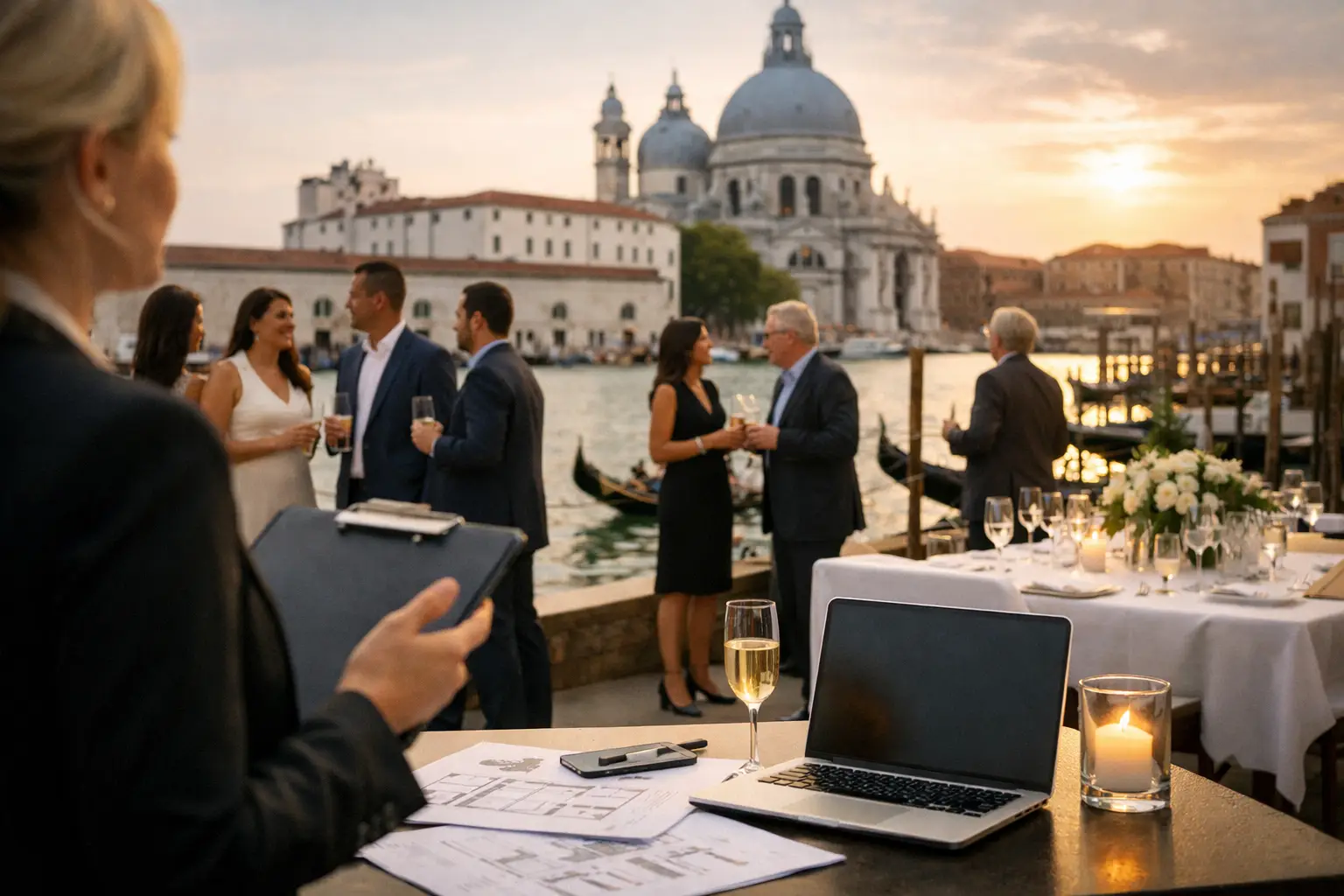
A leadership dinner in a Renaissance palace sounds effortless until the first guest lands late, the tide shifts, and a private transfer window disappears. That is why venice executive event planning is never just about selecting an impressive venue. It is about controlling movement, timing, guest experience, and local variables in a city that rewards expertise and exposes weak coordination quickly.
For international agencies and corporate teams, Venice can be one of the most effective destinations in Italy for executive programs. It is visually unmistakable, compact enough to feel exclusive, and rich in venues that carry genuine weight. It also operates by rules that differ sharply from Rome, Milan, or Florence. Ground transportation is replaced by water logistics. Load-in schedules are tighter. Privacy, access, and seasonality matter more than many first-time planners expect.
When the audience is senior leadership, top clients, board members, or high-value partners, there is little room for friction. The event must feel polished from the first arrival to the final farewell, with every transition handled confidently and every setting aligned with the brand.
Why Venice executive event planning requires a different approach
Venice is not difficult in the abstract. It is difficult for teams treating it like a standard city. The same qualities that make it extraordinary for executive events also make it operationally sensitive.
The city offers immediate impact. Guests step into a destination that feels distinct from any conventional business hub. Historic palazzos, private terraces overlooking the Grand Canal, intimate luxury hotels, and discreet islands create an atmosphere that is both elevated and memorable. For executive audiences, that matters. The setting shapes perception before the first presentation begins.
At the same time, Venice has physical limits. Access points are narrower, transfer times are influenced by water traffic, and some premium venues require carefully staged setup plans. A program that looks simple on paper can become exposed if transportation, production timing, guest flow, and supplier coordination are not managed as one connected system.
This is where local control changes the outcome. Strong planning in Venice is less about adding complexity and more about removing uncertainty. Guests should never feel the mechanics behind the experience, but the operator absolutely needs to account for them.
Venue strategy matters more than venue glamour
Executive events in Venice often begin with a venue shortlist built around visual appeal. That is understandable, but it is not enough. The right venue is the one that supports the event objective, accommodates the movement plan, and maintains the correct level of privacy and service.
A board dinner, investor reception, leadership offsite, or incentive program finale may all suit Venice, but they do not require the same setting. A grand heritage property can be ideal for a formal gala, while a more discreet boutique venue may serve a senior working session better. In some cases, the most impressive choice is not the largest or most famous location. It is the venue that allows the event to run calmly, protects guest comfort, and supports the schedule without strain.
Historic venues also come with practical considerations. Power access, staging limitations, acoustics, catering logistics, and arrival sequencing all need review early. A refined event experience depends on this work being done well in advance, not improvised during production.
That balance between atmosphere and operability is central to Venice executive event planning. The venue should elevate the program, not create avoidable risk.
Transportation is part of the experience, not just a service line
In Venice, transportation defines the event rhythm. Airport arrivals, train station pickups, hotel check-ins, venue transfers, and departures all depend on accurate marine logistics and realistic timing.
For executive guests, this matters immediately. A delayed water transfer, a confusing docking point, or a poorly sequenced arrival undermines the premium tone before the event has started. By contrast, a well-managed arrival feels controlled and effortless. Guests are met clearly, escorted efficiently, and moved through the city with confidence.
This requires more than booking boats. It means understanding docking restrictions, traffic patterns on the canals, baggage handling realities, backup options during weather shifts, and how transfer schedules interact with venue access times. It also means recognizing that not every guest has the same needs. VIP arrivals, security protocols, multilingual hospitality staffing, and private schedules may all need tailored handling.
For larger executive groups, staggered transport can sometimes work better than trying to move everyone at once. For smaller senior gatherings, privacy may take priority over speed. The correct solution depends on the audience and the event format.
Guest experience depends on invisible precision
Senior audiences notice details quickly. They may never comment on them directly, but they register when hospitality is calm, when transitions feel intuitive, and when the program respects their time.
That level of confidence comes from disciplined planning behind the scenes. Rooming lists need to be accurate. Registration must be discreet and efficient. Meeting spaces should be set correctly the first time. Food and beverage timing has to support the agenda rather than interrupt it. Evening experiences must feel purposeful, not decorative.
In Venice, the strongest executive programs often blend business structure with destination character in measured ways. That might mean a strategy session in a private palace followed by a canal-side aperitivo, or a high-level meeting paired with an exclusive cultural access experience after hours. The point is not to overprogram the schedule. It is to use Venice with restraint and intelligence.
Executive groups rarely want tourism disguised as business hospitality. They want authenticity, privacy, and quality. The destination should feel curated, not staged.
The real value of local supplier relationships
Many event plans look solid until they reach the delivery phase. That is usually where local relationships prove their worth.
Venice rewards planners who know which suppliers are reliable under pressure, which venues communicate clearly during lead-up, and which partners can adapt when timings change. On paper, two providers may appear similar. In practice, one may respond quickly, understand international expectations, and solve problems before they escalate. The other may not.
This is especially relevant for executive events, where the margin for visible correction is small. Last-minute adjustments to catering, production, floral design, entertainment timing, or transfer routing need fast decisions and local authority. If every issue has to move through several layers of interpretation, the event loses momentum.
An experienced destination partner brings more than contacts. They bring judgment. They know when to simplify a plan, when to invest more heavily in a high-visibility touchpoint, and when a beautiful idea is not worth the operational compromise.
What international planners should define early
The best Venice programs start with a clear brief. Not just guest numbers and dates, but the actual intent of the event. Is this about recognition, relationship-building, strategic discussion, product positioning, or leadership alignment? Once that is clear, the event architecture becomes much stronger.
Budget should also be framed correctly from the start. Venice can deliver exceptional value at the executive level, but it is not the place for assumptions based on standard city costs. Transport, access, premium venue use, and guest service levels all influence the final structure. Clarity early on prevents rushed decisions later.
It also helps to define the non-negotiables. That could be privacy, a central hotel cluster, strong branding opportunities, high-touch arrivals, or a heritage venue with exclusive use. When priorities are ranked honestly, the planning process becomes more efficient and the outcome more aligned.
For many overseas planners, the most practical choice is working with an in-country specialist who can manage sourcing, logistics, and live execution as one joined-up operation. That is often the difference between a beautiful concept and a dependable event.
Love IT DMC approaches Venice this way because executive events succeed when operational control and destination quality support each other at every stage.
Venice executive event planning is about confidence
The city does not need embellishment. Venice already carries presence, history, and distinction. The job of the planner is to shape those qualities into an experience that feels exact, polished, and entirely under control.
When done well, Venice becomes more than a backdrop for an executive program. It becomes a strategic asset – a destination that reinforces brand stature, rewards key stakeholders, and leaves guests with a strong sense that every detail was considered.
That standard is achievable, but only with planning that respects the city as it is. The most successful events here are not the loudest or the most complicated. They are the ones that move with precision, host with confidence, and make excellence feel natural.

