A leadership retreat succeeds when the setting changes the quality of the conversation. When international teams assess the top executive retreat destinations Italy offers, they are not simply choosing attractive scenery. They are choosing the conditions for confidential decisions, focused collaboration, meaningful recognition, and a program that respects senior leaders’ limited time.
Italy offers an unusually broad range of options within one country: private lakeside villas, Renaissance cities, discreet countryside estates, coastal resorts, and historic urban palaces. The right choice depends on the purpose of the meeting, the size and profile of the group, the required level of privacy, and how much travel time the agenda can absorb. For executive programs, operational discipline matters as much as visual impact.
How to Choose an Executive Retreat Destination in Italy
The first question is not “Which destination is most beautiful?” It is “What must this retreat achieve?” A board strategy session requires controlled access, secure meeting space, and minimal distractions. A leadership incentive may benefit from a more expansive program, with regional food, cultural access, and outdoor experiences that strengthen relationships beyond the conference room.
Air connectivity is the next practical filter. For a two-night retreat, a destination within efficient reach of Milan, Rome, Florence, or Venice often protects valuable working time. For a three- or four-night program, a more remote setting can be worthwhile, especially when the journey itself supports a sense of occasion.
Venue configuration also deserves early attention. A beautiful property may be ideal for 20 senior guests yet unsuitable for a plenary meeting, private breakouts, or a gala dinner with production requirements. Executive groups need discreet arrivals, reliable transfers, flexible dining, strong audiovisual infrastructure, and a clear contingency plan for weather or traffic disruption.
Top Executive Retreat Destinations Italy Offers
Lake Como: Privacy, Prestige, and Proximity to Milan
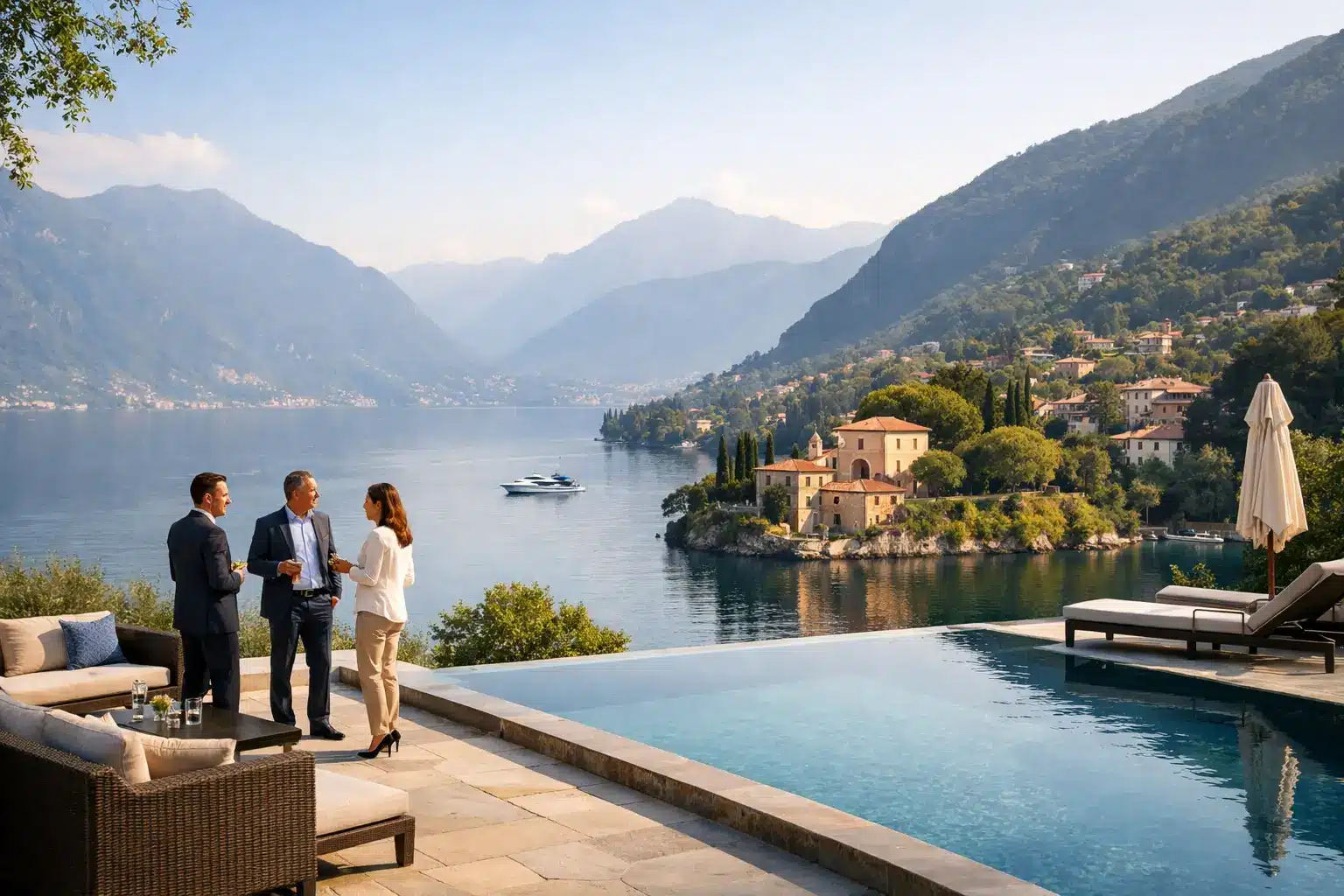
Lake Como remains one of Italy’s strongest choices for high-level leadership groups. Its appeal is immediate: grand villas, composed gardens, mountain views, and a polished hospitality culture that feels exclusive without becoming theatrical. With Milan’s airports and rail connections within practical reach, it works particularly well for international groups arriving from multiple markets.
For an executive retreat, the lake’s greatest advantage is its ability to create separation from daily business while maintaining accessibility. Private boat transfers can turn movement between a hotel, villa, and dinner venue into part of the experience. A closed-door strategy session can be followed by an intimate dinner in a historic residence, with the program paced around the group’s priorities rather than a public tourist schedule.
There are trade-offs. The most sought-after properties have limited inventory, and the lake’s narrow roads require precise transfer planning. Peak-season demand can affect both availability and rates. For groups that need high privacy, advance control of access points, boat schedules, and guest flow is essential.
Tuscany: Space for Strategy and Shared Experience
Tuscany is the natural choice when a retreat needs room to breathe. Vineyard estates, restored farmhouses, and country resorts offer a calmer rhythm than a major city, making the region well suited to leadership alignment, management off-sites, and incentive programs that combine business content with genuine connection.
The destination’s strength lies in its variety. A group can hold morning sessions in a converted wine cellar or contemporary meeting room, then move into experiences that feel rooted in place: a private winery visit, a chef-led regional dinner, a guided art encounter, or a relaxed afternoon among the hills. These moments are not filler. Used well, they give senior teams space to continue conversations in a more informal setting.
Florence and Pisa provide the most practical gateways, while Rome can support certain southern Tuscan itineraries. Tuscany is best for groups with at least three days on the ground. Trying to fit a countryside program into one short overnight stay can create unnecessary travel and dilute the value of the setting.
Rome: Authority, Culture, and High-Impact Hospitality
Rome is an exceptional option for executive groups that need substance, access, and a powerful sense of place. The city supports formal board-level meetings, international leadership forums, and VIP recognition programs with equal credibility. Its airport connectivity, broad hotel base, and range of historic venues make it particularly effective for groups whose attendees are arriving from across the United States, Europe, and the Middle East.
The strongest Rome programs balance the city’s scale with carefully managed intimacy. A private palace dinner, after-hours cultural visit, or rooftop reception can feel deeply personal when timed and produced correctly. Meanwhile, premium hotels and private residences offer the meeting privacy, security protocols, and technical reliability required for sensitive executive agendas.
Rome does demand disciplined logistics. Traffic patterns, restricted-access areas, and the distance between major landmarks can affect timing quickly. The solution is not to overpack the agenda. It is to design a program around well-chosen zones, protected transfer windows, and venues that allow guests to remain in one controlled environment when appropriate.
Venice: A Distinctive Setting for Senior Recognition
Venice is best reserved for programs where the destination itself is part of the message. Few cities create a stronger arrival experience, and few can match its potential for private cultural moments. For leadership recognition, client hosting, or a small executive council meeting, Venice delivers an atmosphere of rarity that is difficult to reproduce elsewhere.
A well-designed Venetian retreat relies on pacing. Water transfers replace road transportation, and a private palazzo can host a board dinner with a sense of occasion that no conventional ballroom can provide. The city works especially well for compact groups that value cultural distinction and are comfortable with a more curated, less conventional operating environment.
Accessibility and production need close review. Water logistics require experienced coordination, and some historic venues have restrictions around equipment, load-in, noise, or timing. Venice rewards careful advance planning. It is not the destination for a last-minute agenda with frequent venue changes.
Milan: Efficient, Contemporary, and International
Milan is often underestimated as an executive retreat destination because it is known first as a business capital. That is precisely why it performs so well for leadership groups with demanding agendas. It offers direct international air access, sophisticated hotels, excellent restaurants, design-led spaces, and a corporate infrastructure that supports efficient delivery.
For companies seeking a modern Italian expression, Milan can combine serious daytime work with memorable evening programming. Private fashion, design, automotive, or culinary experiences can be tailored to the group’s interests without requiring long transfers. It is also an effective gateway for a split itinerary, pairing a city-based meeting with Lake Como or the Piedmont wine region.
The trade-off is that Milan does not automatically create the psychological distance of a countryside retreat. The program must deliberately build that separation through the venue choice, hotel experience, and off-site moments. For a one- or two-night executive meeting, however, its efficiency is often the smarter choice.
Sicily: Reward, Perspective, and Longer-Stay Value
Sicily offers a more expansive proposition for executive groups: dramatic landscapes, layered history, exceptional food, and resort settings that support privacy at a larger scale. It is particularly compelling for leadership incentives, annual top-performer programs, and strategic gatherings where a longer stay can justify the journey.
From Taormina and Mount Etna to Palermo’s historic architecture and the island’s coastal resorts, Sicily can feel both distinctly Italian and entirely different from the classic north-and-central Italy itinerary. The destination is well suited to programs that mix structured meetings with restorative time, private dining, and locally grounded experiences.
Its main consideration is travel. Flight schedules, driving times, and seasonal weather should shape the itinerary from the start. For groups with only two nights, the transfer burden may outweigh the benefit. With three or more nights and the right operational plan, Sicily can deliver a level of immersion few destinations can match.
The Difference Between a Beautiful Retreat and a Productive One
A destination should support the business objective rather than compete with it. Senior attendees notice the details: whether arrivals are calm, whether meeting rooms are properly configured before they enter, whether privacy is protected, and whether transitions feel effortless. Those details determine whether Italy feels like a strategic investment or an avoidable operational risk.
This is where an in-country partner brings real value. Love IT DMC coordinates destination selection with venue access, transportation routing, supplier management, production timing, and guest experience, so the creative ambition of a retreat remains grounded in practical control.
The best destination is the one that gives your leadership team the right distance from routine, without creating distance from the work that matters. Begin with the outcome you want from the room, then build the Italian setting around it.

