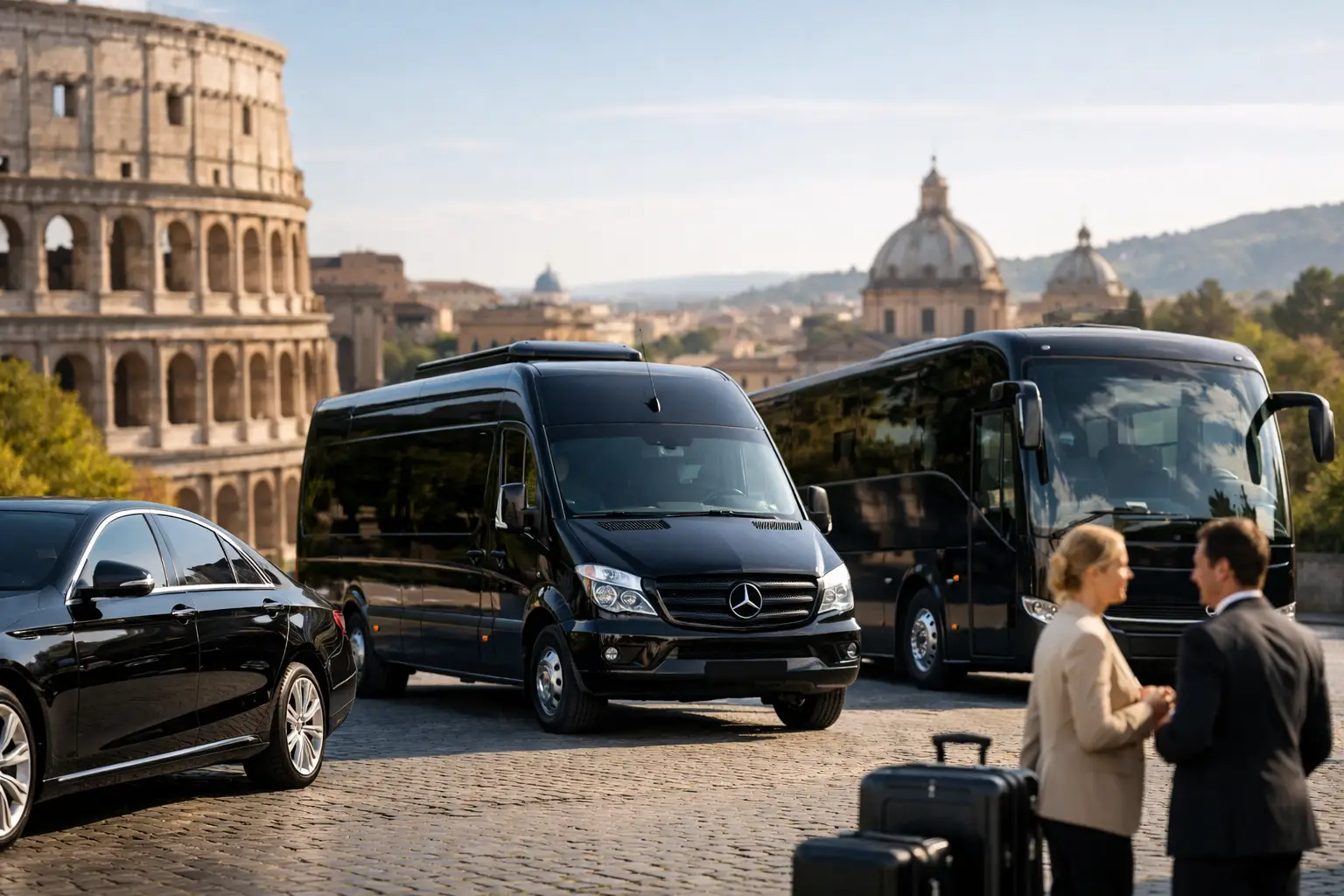
When 300 guests land within a two-hour window at Milan Malpensa, another VIP delegation arrives by private jet at Linate, and dinner service starts inside a historic venue with strict access times, transportation stops being a background task. It becomes the structure holding the entire program together. That is why italy event transportation logistics deserves early strategic attention, not last-minute coordination.
For international agencies and corporate teams planning programs in Italy, transportation is rarely just about moving people from one point to another. It affects guest mood, punctuality, staffing, security, branding, and the credibility of the event itself. A beautiful agenda can lose impact quickly if arrivals are fragmented, transfer times are misjudged, or coaches cannot reach a venue at the required hour.
Why Italy event transportation logistics is unusually complex
Italy rewards well-planned events with extraordinary settings, from palaces in Rome to lakeside estates near Como and private cultural venues in Florence or Venice. The same qualities that make these destinations memorable also create operational complexity. Historic city centers have restricted traffic zones, vehicle permits, narrow access points, and limited loading windows. Waterfront transfers may require a combination of road and boat transport. Rural luxury properties may offer exceptional privacy while being farther from airports and rail hubs than overseas planners expect.
This is where experience matters. Distances on a map do not tell the full story in Italy. A transfer that looks simple can be affected by local traffic patterns, event-day restrictions, fashion week congestion in Milan, religious celebrations in Rome, or peak tourism pressure in Venice and Florence. Timing must be built from real operating conditions, not ideal assumptions.
The strongest transportation planning starts with a full reading of the program. Arrival patterns, attendee profiles, hotel allocations, venue access rules, hospitality standards, and contingency requirements all shape the transport plan. If one piece changes, the rest must adjust with it.
The real job is guest flow, not just vehicles
A common mistake in event planning is to think of transportation as a procurement line item. In practice, it is a guest flow system. The number of vehicles matters, but the sequencing matters more.
An executive board meeting in Rome requires a different transport logic than a product launch in Florence or a multi-hotel incentive in Sicily. Senior leadership may need private movements with security buffers and flexible departure times. A larger conference group may need wave-based departures, multilingual airport staffing, branded signage, luggage handling, and tightly managed hotel-to-venue rotations. The right plan reflects the experience expected by each guest segment.
There is also a trade-off between efficiency and atmosphere. Consolidated group transfers are cost-effective and easier to control, but they may not suit VIP guests or luxury incentive programs where privacy and pacing are part of the experience. On the other hand, fully individualized movements can increase cost, staffing pressure, and scheduling risk. Good planning finds the right balance rather than forcing one model onto every group.
Airport arrivals are where confidence is won
The first live moment of an event often happens at the airport. Guests are tired, attention is limited, and even small confusion feels larger than it is. Clear staffing, visible signage, accurate manifest management, and live communication are essential.
For international groups, this often includes multilingual airport coordinators, direct contact between dispatch and on-site teams, and real-time adaptation when flights are delayed or guests miss connections. A static spreadsheet will not carry an arrival operation through a full event day. Teams need current information, clear escalation paths, and enough local authority to make quick decisions.
This is especially relevant in Italy, where guests may arrive through multiple gateways depending on destination and airline routing. A single event in Tuscany may involve Florence Airport, Pisa Airport, and high-speed rail arrivals from Rome or Milan. Without a unified transport command structure, fragmentation appears quickly.
Planning for Italian cities requires local judgment
Every major destination in Italy has its own transport character. Rome combines grandeur with unpredictability. Travel times can shift sharply, and access around central historic areas must be verified carefully. Milan is more structured but can tighten significantly around major fairs, design events, and business peaks. Florence demands precision because the historic center limits vehicle movement and many premium venues require carefully timed access. Venice is in a category of its own, where the transport plan may involve road vehicles, private launches, public landing stages, porters, and weather considerations.
That is why a national strategy still needs city-level expertise. A transportation framework that works in Milan may not translate directly to Venice. Even within one destination, a gala in a heritage venue and a conference in a modern congress center require different timing models, vehicle types, and staffing ratios.
Venue access can shape the whole agenda
Experienced planners know that the transfer schedule should never be built in isolation from the venue. Access restrictions, coach parking, guest drop-off procedures, loading timing, and local authority permissions can alter the event flow more than expected.
This is particularly true for iconic venues. Historic properties often preserve their exclusivity through tight operational controls. That may mean staggered arrivals, smaller shuttle vehicles for final approach, or buffer holding areas before guests enter. None of this is a problem when built into the plan early. It becomes a problem when transportation is confirmed after the guest journey has already been promised.
For this reason, transport teams should be involved during venue planning, not after contracts are signed. It protects timing, cost control, and guest experience all at once.
What strong italy event transportation logistics looks like in practice
Reliable execution is visible in details that guests may never consciously notice. Vehicles arrive in the correct sequence. Staffing is positioned before the first arrival, not after. Drivers have final manifests, route notes, and updated timing. Hotel departure waves match registration capacity at the venue. VIP movements are discreet. Luggage follows the guest journey without confusion. When changes happen, they are absorbed calmly.
Operationally, this usually depends on several layers working together. There is the strategic transport plan, then the dispatch structure, then the on-site control team. There are confirmed route checks, supplier briefings, and contingency scenarios for late flights, road closures, weather shifts, or program overruns. This level of control is what allows the event to feel effortless.
At Love IT DMC, this approach is central to how transportation is managed across meetings, incentives, congresses, and executive programs in Italy. The objective is not simply to provide vehicles. It is to maintain timing, protect the guest experience, and support the larger commercial purpose of the event.
Cost control matters, but not in the abstract
Transportation budgets deserve discipline, especially for large programs with multiple movement days. Still, the lowest quote is rarely the most efficient decision. Under-scoped staffing, unrealistic transfer timing, or the wrong vehicle mix can create higher costs later through delays, overtime, or service recovery.
A better approach is to assess cost against program risk. If a congress depends on moving 800 attendees from several hotels to a morning plenary, transport planning should be built around attendance certainty and arrival precision. If an incentive trip centers on experience and prestige, the service style may justify a more tailored fleet and higher staffing ratio. Neither approach is inherently right in every case. It depends on the event objective.
The same applies to contingency planning. Backup vehicles, holding capacity, and operational float time may appear conservative on paper, but they often protect the budget by preventing larger disruptions. In high-stakes events, resilience is part of efficiency.
The value of one local command point
International planners often work across global stakeholders, agency teams, hotel partners, venues, and local suppliers. Transportation touches all of them. Without one in-country lead managing the moving parts, communication becomes fragmented and accountability becomes blurred.
A single command point simplifies decision-making. It keeps manifests aligned with rooming lists, ties airport services to hotel check-in timing, matches departures to agenda changes, and ensures suppliers are briefed to one operational standard. It also gives overseas planners something they value highly during live days – clarity.
That clarity matters most when the schedule tightens. A late keynote, a weather shift on the coast, a delayed inbound group from the US, or a change in security protocol can all require immediate transport adjustments. The right local partner does not just relay issues. They solve them on the ground, with authority and calm.
Italy offers extraordinary settings for business events, but those settings reward precision. The experience guests remember at the gala dinner, conference opening, or executive retreat often depends on decisions made much earlier in the transport plan. When movement is handled with discipline and local insight, everything else has more space to impress.

