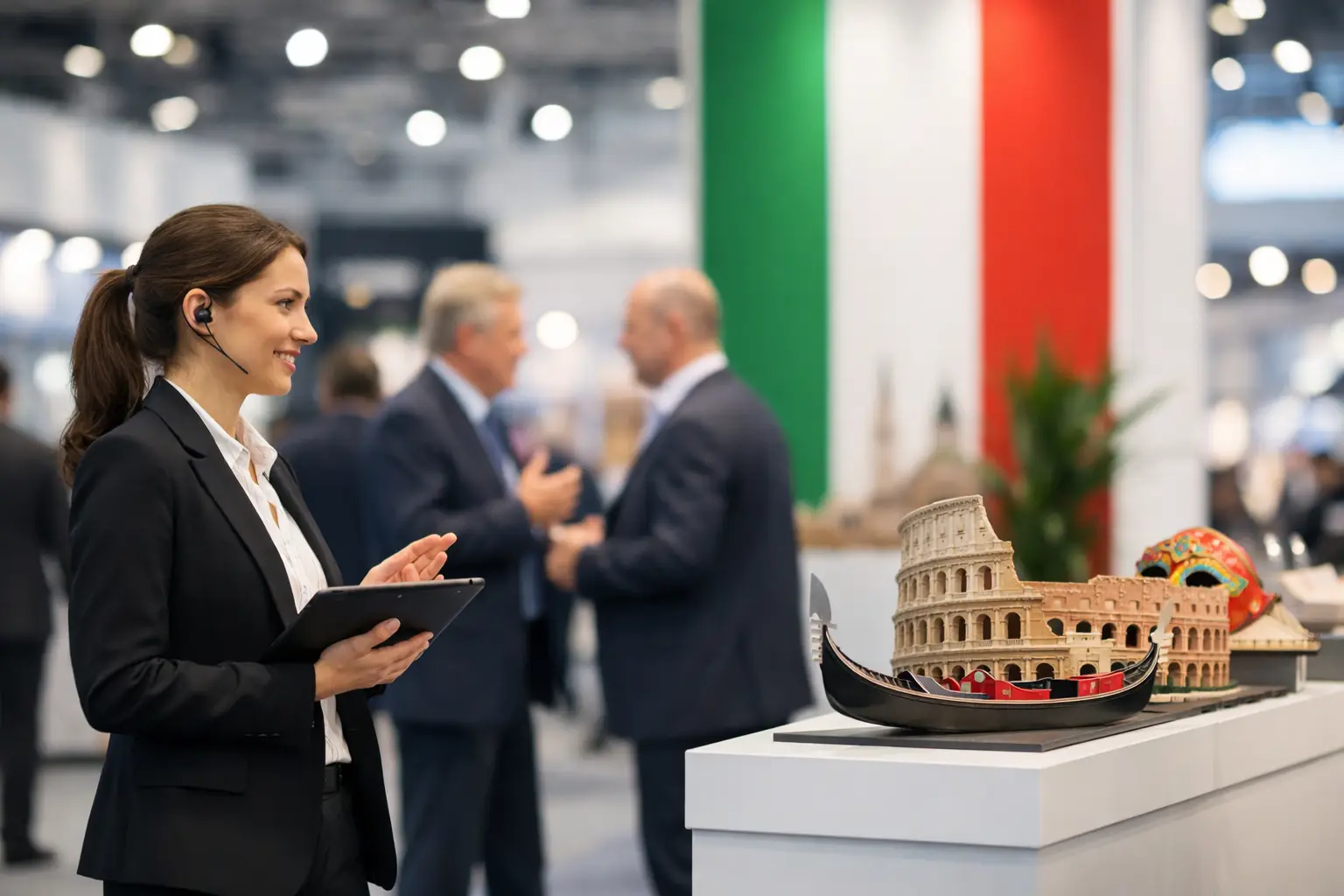
At an exhibition in Italy, the difference between a polished brand presence and a stressful week usually comes down to what happens behind the stand. Italy exhibition event support is not only about setup crews and transport schedules. It is about protecting timelines, controlling vendor coordination, managing attendee flow, and making sure every visible detail reflects the standards of the brand behind the event.
For international agencies and corporate teams, that challenge is amplified by language, venue rules, regional operating differences, and the pressure of delivering for stakeholders who expect everything to run exactly as promised. Italy is an exceptional exhibition market, but it rewards preparation and local control. The most successful events here are built on both.
What Italy exhibition event support actually covers
Many planners use the phrase broadly, but in practice, exhibition support in Italy sits across several operational layers. The visible layer includes venue access, exhibitor registration assistance, staffing, transportation, technical coordination, guest management, and hospitality delivery. The less visible layer is often the one that determines success: production schedules, supplier timing, permit checks where needed, load-in restrictions, power and technical confirmations, branded collateral handling, and contingency planning.
In cities such as Milan, Rome, Florence, and Venice, no two exhibition environments work in exactly the same way. A major exhibition center in Milan requires one kind of operational discipline. A brand activation tied to a trade fair in a historic venue in Florence requires another. Venice introduces entirely different transport considerations, where water logistics can affect timing, loading methods, and staffing plans. Treating Italy as one uniform market is where avoidable mistakes begin.
That is why experienced in-country support matters. A local team is not simply there to execute instructions. It should pressure-test the plan against reality on the ground.
Why international planners need local control in Italy
Exhibitions are schedule-sensitive by nature. There is very little room to recover from late freight, incorrect access documentation, underestimating transfer times, or misaligned supplier arrivals. When teams are coordinating remotely from another country or time zone, small misunderstandings can create expensive delays.
A strong local partner reduces that risk because they are operating inside the destination, not viewing it from a planning document. They know which venues are straightforward and which require tighter sequencing. They understand when a transfer that looks simple on paper may become difficult due to traffic patterns, city access limits, or concurrent events. They know how to coordinate with local suppliers in a way that produces answers quickly rather than after several rounds of clarification.
This is especially valuable for agencies managing multiple stakeholders. Your client may be focused on brand visibility. Procurement may be focused on cost control. Internal leadership may be focused on guest experience and ROI. Exhibition event support in Italy has to satisfy all three at once. That requires operational rigor, but also the ability to make practical trade-offs without compromising the event.
The cost of getting support wrong
Poor exhibition support rarely fails in one dramatic moment. More often, it erodes confidence in stages. A vehicle arrives late. A supplier misses a technical detail. Guest hosts do not have the final attendee list. VIP transfers are handled as standard transfers. A post-show dinner starts behind schedule because exhibitor breakdown ran longer than expected.
Each issue may seem manageable on its own. Together, they change how the event is experienced by attendees and judged by decision-makers. For premium brands and high-stakes corporate programs, that is not a small problem. It affects reputation.
The operational areas that matter most
The most effective Italy exhibition event support begins before anyone arrives on site. Venue sourcing and site assessment are often the first critical step, particularly when the exhibition itself is only one part of a larger program. A company may need meeting rooms for private discussions, a nearby hotel block for delegates, transfer planning across multiple arrival points, and an evening venue that feels distinctly Italian without becoming logistically difficult.
Transportation is usually where complexity shows itself fastest. Italy offers extraordinary event settings, but movement between airports, hotels, exhibition venues, and off-site functions has to be planned with precision. Group sizes, luggage volumes, arrival waves, exhibitor materials, and VIP routing all need separate consideration. A good transport plan is not only efficient. It is also realistic.
Staffing is another area where quality has a direct impact on perception. Exhibition support teams may include multilingual hosts, registration staff, coordinators, interpreters, technical contacts, and hospitality personnel. The right staffing structure depends on the audience profile and event objectives. A medical congress attached to an exhibition requires a different front-of-house approach than a luxury product showcase or a B2B trade fair presence.
Then there is guest experience. This is where Italy has a unique advantage when handled correctly. An exhibition schedule can feel transactional if every touchpoint is limited to the show floor and a business hotel. It becomes more memorable when the surrounding program is designed with intention – a private dinner in a historic palazzo, a reception with views over Rome, a contemporary venue in Milan with precise branding, or a closing event in Florence that balances local character with business polish. These choices should support the commercial purpose of the event, not distract from it.
Italy exhibition event support for agencies and corporate teams
Agencies and corporate organizers often need different things from a local partner, even when the event format looks similar.
Agencies usually need flexibility, speed, and confidence that the local delivery team will protect the client relationship. They may already own the creative direction and broader strategy, but they need in-country execution that is disciplined, responsive, and discreet. The right support team understands when to lead, when to advise, and when to stay invisible while keeping the operation under control.
Corporate teams often place greater emphasis on internal alignment, compliance, attendee communications, executive handling, and budget accountability. They may need help connecting the exhibition with leadership meetings, incentives, customer dinners, or post-event reporting. In those cases, support should extend beyond the show itself and into the full business program around it.
This is where a destination management approach adds value. Instead of handling the exhibition as an isolated task, it connects venue strategy, movement, accommodation, hospitality, and guest experience into one operating plan. That creates fewer handoffs, fewer gaps, and stronger accountability.
Choosing the right support partner in Italy
Not every local supplier is built for exhibition work at an international standard. Some are strong in hospitality but weaker in production control. Some know venues well but struggle with large-group logistics. Others can arrange services but do not provide the level of strategic oversight overseas planners actually need.
A reliable partner should be able to speak clearly about timing, supplier management, escalation procedures, city-specific constraints, and contingency planning. They should be comfortable working with international approval structures and understand that transparency matters as much as creativity. If something is likely to affect budget, access, or schedule, you should hear about it early.
It also helps to look at how they think about Italy itself. The best exhibition support providers do not treat Italian heritage as decoration. They know how to use place with purpose. A venue should fit the brand. A gala should justify the transfer time. A cultural touchpoint should feel considered, not generic. Sophistication in Italy comes from judgment.
Love IT DMC works in exactly that space – combining operational control with the destination knowledge needed to turn an exhibition trip into a stronger brand experience.
What good support looks like on site
On site, quality is visible in calm execution. Credentials are ready. Staff know the program. VIP movements do not interrupt general operations. Last-minute changes are absorbed without confusion reaching the client. The evening event starts on time, even if the show floor closes late. Attendees feel guided rather than managed.
That level of delivery is rarely accidental. It comes from detailed pre-event planning, realistic scheduling, disciplined supplier communication, and experienced local leadership. It also comes from knowing where flexibility is possible and where it is not. In exhibition environments, that distinction matters.
Italy offers exhibition organizers something few markets can match: global business relevance combined with venues, cuisine, architecture, and atmosphere that elevate every interaction around the event. But the standard is high. Guests notice quality here, and they notice inconsistency just as quickly.
The right support does more than keep the event on track. It allows your team to focus on clients, stakeholders, and outcomes while the local operation is handled with precision. In a market as rewarding and as nuanced as Italy, that is not a luxury. It is the foundation of a successful exhibition program.
If you are planning an exhibition presence in Italy, think beyond the booth footprint. The strongest results usually come from what your attendees never have to notice – because every detail has already been handled.

