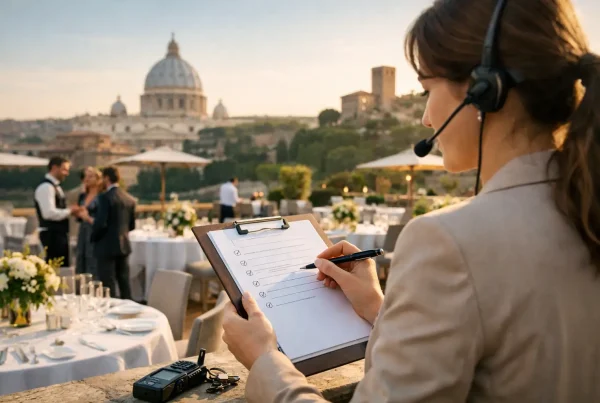
A Roman palazzo may look ideal in a proposal deck, yet the decisive question is often whether 180 guests, production equipment, catering teams, and coaches can arrive and depart on schedule. That is the reality of how to source venues in Rome: selecting a remarkable setting is only the starting point. The right venue must also support the program, the guest journey, the brand objective, and the operational detail that makes a high-stakes event feel effortless to attendees.
For international agencies and corporate teams, Rome offers exceptional range. A board meeting can take place in a contemporary hotel near major transport routes; an incentive dinner can unfold in a private palace; a product launch may call for an industrial space, garden, museum, or rooftop with a view of the city skyline. Each comes with a different operating model. Early local evaluation prevents beautiful ideas from becoming expensive complications.
Start venue sourcing in Rome with the event brief
A strong venue search begins with a brief that goes beyond date, delegate count, and budget. Define the purpose of the gathering first. Is the event designed to inform, reward, sell, celebrate, or build relationships? A leadership meeting requires privacy, concentration, and reliable technical infrastructure. A gala dinner requires arrival impact, hospitality flow, and enough room for service and entertainment. An incentive experience may prioritize authenticity and exclusivity over a conventional meeting layout.
The attendee profile matters just as much. International executives arriving after a long-haul flight need a different pace from a local sales force attending an evening celebration. Consider accessibility requirements, security expectations, language needs, dietary complexity, and the proportion of guests who will move together by coach or private transfer.
Before approaching venues, establish the non-negotiables: preferred areas, desired format, seating style, minimum ceiling height for production, available dates, program timings, and an all-in budget range. It is also useful to identify what can flex. For example, a panoramic terrace may be a priority, but the exact neighborhood may not be. Clarity allows local teams to bring forward the right options rather than simply the most recognizable ones.
Match the venue type to the experience you need
Rome should not be sourced as one destination. Its neighborhoods, traffic patterns, architectural restrictions, and venue categories create very different event conditions.
Hotels and dedicated congress venues are usually the most efficient choice for large meetings, conferences, and events requiring multiple breakout rooms. They offer integrated accommodations, established AV capability, dependable loading access, and experienced banquet operations. The trade-off is that they may deliver less of the immediate sense of place that many international groups expect from Rome.
Historic palaces, villas, museums, and academies bring the city’s cultural depth directly into the event. They can turn a gala dinner or awards ceremony into a genuine brand moment. However, heritage venues often have carefully defined rules around guest capacity, open flames, sound levels, wall fixings, equipment weight, and access hours. Their beauty is precisely why they require considered production planning.
Rooftops, gardens, and terraces are especially effective for welcome receptions, networking events, and summer celebrations. They offer drama with relatively light staging, but weather protection, wind conditions, elevator capacity, and neighborhood noise restrictions must be assessed early. A rain plan cannot be an afterthought in an outdoor Roman venue. It must be an equally credible guest experience.
Contemporary galleries, former industrial sites, and private clubs suit brands looking for a more unexpected setting. These spaces can offer creative freedom, though they may require greater investment in lighting, furniture, kitchens, power distribution, and temporary infrastructure. A lower venue rental fee does not always mean a lower overall event cost.
Assess access before falling in love with the setting
Rome’s historic center is compelling because it is historic. Narrow streets, protected zones, pedestrian areas, and limited vehicle access are part of the destination’s character. They are also central to venue feasibility.
Ask early how guests will arrive, where vehicles can stop, how long they may wait, and what walking distance remains from the drop-off point to the entrance. For a group dinner, a five-minute walk can be perfectly reasonable. For a formal awards evening in eveningwear, or for guests with mobility needs, that same walk may alter the experience significantly.
Production access deserves the same scrutiny. Confirm loading doors, vehicle restrictions, lift dimensions, stairs, permitted load-in windows, storage areas, and the route from truck to event space. A venue with an elegant main entrance may have a very limited back-of-house route. This affects not only suppliers but also installation time, labor costs, and the type of scenic or audiovisual design that is realistic.
Timing is another operational consideration. A Rome itinerary can look compact on a map while taking longer in practice because of traffic, coach routing, security checks, and peak visitor periods. The best venue choice is often the one that protects the entire program, not necessarily the one with the most famous view.
Confirm technical capacity, permits, and venue restrictions
A venue should be evaluated as an operating environment, not simply a room. During sourcing, confirm its available power supply, backup provisions, internet capability, heating or cooling, restroom capacity, kitchen facilities, and emergency procedures. If the event includes live entertainment, LED walls, translation, streaming, or substantial lighting, verify exactly what is included and what must be brought in.
Historic and outdoor spaces may require permits or formal approvals for amplified music, extended hours, structures, branding, street occupation, special effects, or public-facing activity. Approval timelines can vary, and some requests depend on the venue’s own license conditions. Treat permissions as a critical path item, particularly for events involving large guest numbers or ambitious production.
Exclusivity also needs precise definition. A venue may be private for an event while public areas, hotel guests, or another function continue to operate nearby. For executive programs, confidential launches, or high-profile celebrations, clarify guest separation, security positions, branding rights, photography rules, and sound containment before contracting.
Build the budget around the complete event, not the rental fee
Venue proposals can be difficult to compare when each includes different elements. One may include furniture, staffing, basic lighting, and standard cleaning, while another presents only the space rental. Request a clear cost structure that separates venue fees, food and beverage minimums, technical services, furniture, security, permits, overtime, staffing, cleaning, transportation, and contingency costs.
This is where experienced local sourcing adds real value. A seemingly premium venue can become the more economical choice when it reduces transfers, minimizes production requirements, or includes essential infrastructure. Conversely, an inexpensive heritage location may require substantial investment to meet a corporate standard for guest comfort, technical delivery, and service flow.
Dates influence both availability and cost. Spring and early fall are highly desirable for Rome, while major city events, trade fairs, religious holidays, and international congresses can place pressure on hotel inventory, transportation, and sought-after venues. Flexibility of even one day can materially improve the shortlist.
Use site inspections to test the guest journey
A site inspection should validate the proposal, not repeat it. Walk the route exactly as a guest would: coach arrival, security or registration, welcome moment, cloakroom, event space, restrooms, dinner area, and departure. Then walk it again from the supplier perspective, checking production routes, holding areas, service access, and emergency exits.
Pay close attention to moments where guests might queue or lose direction. An impressive courtyard can become congested during registration. A dramatic staircase may complicate access for guests with reduced mobility. A beautiful terrace may need a carefully designed circulation plan to prevent service and guest traffic from crossing.
For complex programs, local operational knowledge is the difference between an attractive shortlist and a dependable event solution. Love IT DMC evaluates venues against the full program, coordinating the practical requirements behind the atmosphere: arrival schedules, supplier access, permits, technical specifications, and contingency planning.
Contract with clarity and protect the program
Once a venue is selected, document every commitment. The agreement should identify the contracted rooms and areas, access times, capacity by setup, included equipment, catering terms, payment schedule, cancellation conditions, insurance responsibilities, and restrictions on suppliers, music, branding, or décor.
Ask what happens if weather, transport disruption, or an approval issue affects the program. A practical contingency plan may include earlier transfers, a secondary indoor event space, staggered arrivals, or a revised guest flow. The point is not to overcomplicate the event. It is to make confident decisions before pressure arrives.
Rome rewards ambition when it is supported by local control. Choose the venue that gives your guests a sense of occasion while giving your team the time, access, and certainty to deliver it properly. When the doors open, attendees should notice the grandeur of Rome, not the work required to make it happen.