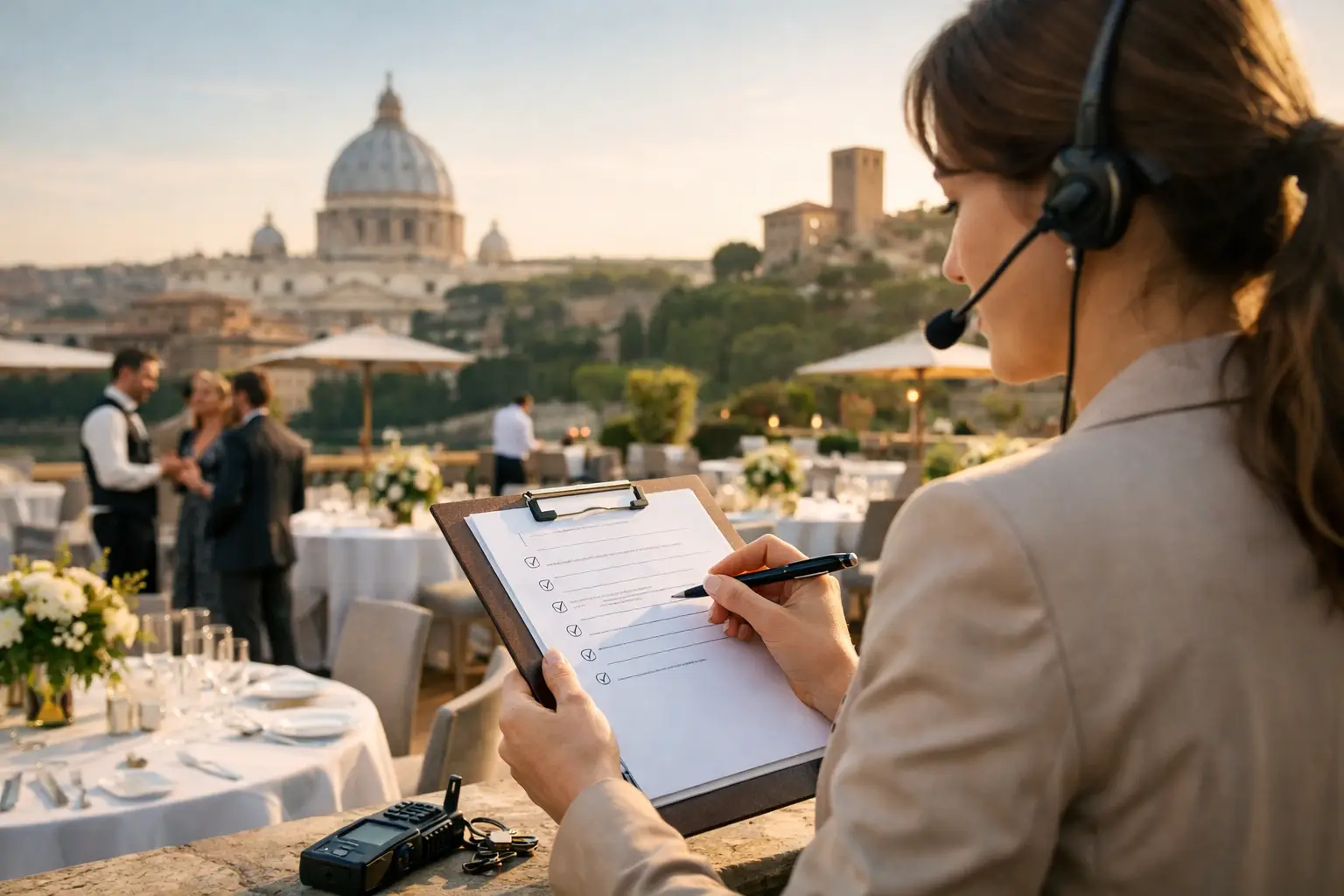
A beautifully chosen venue is only the beginning. When 300 delegates arrive at a Roman palazzo, a Milan congress center, or a Venetian landmark, the onsite event coordination checklist becomes the operational document that protects every promise made during planning. It gives every supplier, host, driver, and event manager clarity on what happens next, who owns it, and how the guest experience remains composed when timing changes.
For international agencies and corporate teams producing events in Italy, onsite coordination requires more than a running order. Historic venues have access restrictions. City traffic affects transfers. Multiple languages, security protocols, VIP arrivals, and food service timings must work together without becoming visible to attendees. The goal is disciplined control behind the scenes and a confident, welcoming experience in front of them.
Build the onsite event coordination checklist around key moments
The most useful checklist follows the guest journey rather than a supplier-by-supplier filing system. Begin with load-in and venue readiness, move through arrivals, registration, content sessions, hospitality, departures, and breakdown. At each stage, identify the owner, deadline, communication method, and contingency action.
A master version should be held by the onsite lead, but each department needs a focused extract. The transportation captain does not need every production cue, while the stage manager must know exactly when coach arrivals could affect the opening session. This prevents information overload while ensuring every team has the decisions that affect its work.
For a complex event, establish a single operational command point. It may be a production office, a discreet room near registration, or a designated mobile communications channel. What matters is that all updates arrive there, are assessed quickly, and are communicated consistently. Parallel conversations are one of the most common causes of avoidable confusion.
Before guests arrive
Venue access is the first critical control point. Confirm loading dock hours, vehicle dimensions, badges, freight elevators, electrical capacity, storage locations, and the final placement of every branded element. In heritage properties, even a small adjustment to signage, furniture, or lighting may require venue approval, so the final walk-through must verify what is actually permitted, not merely what appeared on an early floor plan.
Your pre-arrival checks should confirm:
- Registration desks, devices, badges, alphabetization, and data protection procedures
- Stage, audiovisual, lighting, confidence monitors, presentation files, and backup playback
- Catering setup, dietary requirement labels, service timing, and water stations
- Restrooms, cloakroom, accessibility routes, emergency exits, and wayfinding
- Supplier arrival times, staff uniforms, credentials, and contact numbers
- Weather measures for outdoor receptions, transfers, and terrace activations
Do not treat this as a static inspection. Walk the route as a guest would. Check whether a first-time visitor can locate registration from the drop-off point, whether the path is comfortable for guests with limited mobility, and whether queueing could block a doorway or compromise the visual impact of the venue.
Assign authority before the first complication
An event plan can be detailed and still fail if no one knows who may make a decision. Define a clear escalation structure before doors open. The onsite event director should have final operational authority. Department leads should own transport, registration, production, catering, venue liaison, and guest relations. A client representative should be identified for brand-sensitive decisions, such as changing an executive protocol, modifying a VIP experience, or approving an unplanned cost.
Give each lead practical decision boundaries. For example, a transport manager may reroute coaches around traffic without waiting for approval, but a decision to add vehicles or extend service should be escalated. A catering lead can replenish a station, while a menu substitution for a severe allergy requires a higher level of control. Clear thresholds keep the team responsive without exposing the budget or brand to informal decisions.
Italy rewards local operational knowledge. A procession near a city center, a restricted traffic zone, an unexpected security perimeter, or a delayed water taxi can change the schedule quickly. The right response is not to alarm guests. It is to activate a prepared alternative, update the relevant teams, and communicate a simple next step to attendees.
Control arrivals, registration, and attendee flow
The arrival sequence sets the emotional tone for the entire program. Guests should know where to go before they need to ask. Hosts must be visible, briefing language should be consistent, and vehicle dispatch should align with actual venue access rather than an idealized schedule.
For large groups, create separate arrival lanes where appropriate: VIPs, general delegates, speakers, and guests requiring assistance. This is especially valuable when arrival is concentrated within a short window or when security screening is required. Keep a real-time count of arrivals and no-shows, then share it with catering, transport, and the client contact at agreed intervals.
Registration deserves both hospitality and precision. Prepare an exception process for missing names, replacement badges, late registrations, and guests who arrive with a colleague not included in the manifest. A capable registration desk resolves these matters quietly, away from the main queue, without making an attendee feel like a problem to be processed.
During session changes, do not assume guests will naturally follow signage. Place hosts at decision points, particularly where corridors branch, elevators are involved, or a venue contains several floors. If a plenary finishes late, the team needs to know whether to shorten the coffee break, delay lunch service, or adjust transport departure times. These choices should be made from live information, not guesswork.
Protect the program with live production discipline
A minute-by-minute show flow is essential for any conference, awards dinner, product launch, or executive presentation. It should identify every cue: doors open, walk-in music, speaker call times, video playback, lighting changes, award handovers, meal service, and closing remarks. The document is valuable only if it is actively called and updated onsite.
Hold a concise production briefing before the program begins. Confirm final speaker order, pronunciation, presentation versions, microphone allocation, walk-on routes, and emergency messaging. Speakers should understand where they are expected to wait, who will escort them, and how much time they have. Senior executives should never be left searching for a stage entrance while an audience waits.
Build small time buffers where the event has a high consequence of delay. A gala dinner in Florence may need extra time for guests to move through a historic building. A Venice event may require wider transfer windows because weather and water traffic can affect boats. Buffers are not wasted time when they protect the quality of the experience.
Manage suppliers as one operating team
The venue, caterer, technical crew, entertainment, florist, security team, hostesses, and transportation providers may be separate companies, but guests experience one event. The onsite lead must align them around shared timing, guest priorities, and communication standards.
Use scheduled check-ins rather than waiting for problems. A brief morning meeting, a pre-opening walk-through, and a defined post-program review can be enough for a single-day event. Multi-day congresses often require a daily operations meeting with department leads, including attendance figures, service feedback, staffing changes, weather forecasts, and the next day’s risks.
Supplier management also means protecting the atmosphere. Technical changes, waste removal, stock deliveries, and staff breaks should be planned around guest-facing moments. At a luxury dinner, operational activity should remain discreet enough that the venue’s architecture, food, and hospitality take center stage.
Prepare contingencies without making the event feel defensive
The strongest contingency plans are specific. Rather than listing bad weather as a generic risk, define the trigger, decision time, alternate space, transport impact, revised guest communication, and responsible lead. The same approach applies to delayed speakers, lost luggage, medical issues, technical failure, and transport disruption.
Maintain printed essentials as well as digital files: final floor plans, guest lists where appropriate, emergency contacts, medical information procedures, menus, transport manifests, and key permits. Mobile connectivity can be unreliable in thick-walled historic buildings or remote countryside venues. A printed operational pack is a practical safeguard, not an outdated habit.
At Love IT DMC, local supplier relationships and onsite oversight are treated as part of the guest experience, not separate back-office tasks. The team that knows the venue’s service entrance, the fastest alternate route, and the person authorized to resolve an access issue can preserve both timing and confidence.
Close the event with the same precision
Departures require as much attention as arrivals. Confirm final guest counts, coach loading points, luggage handling, airport transfer waves, and VIP departure protocols. For incentive groups, this may include coordinating individual extensions, rail connections, or private transfers without disrupting the main program.
Before leaving the venue, document any incidents, supplier changes, consumptions, and client requests that affect final reconciliation. Collect feedback while details are fresh, but separate immediate operational facts from broader post-event evaluation. A well-run closeout protects the budget and creates a better foundation for the next program.
The most memorable Italian events appear effortless because the operational work is exact. Give your onsite team a checklist built around real moments, real ownership, and real alternatives. Guests will remember the setting, the welcome, and the confidence of the experience – precisely as they should.