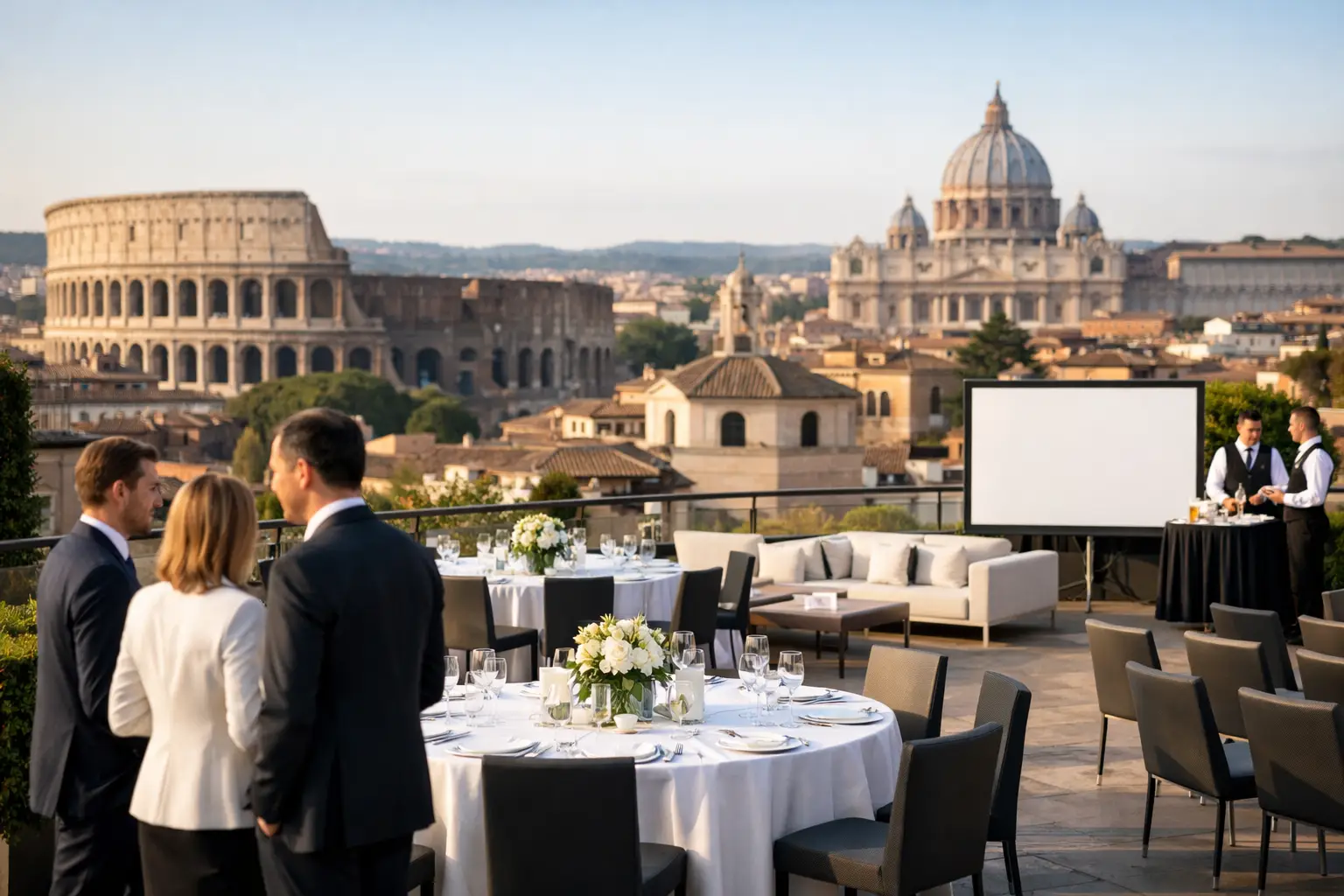
A venue shortlist can look perfect on paper and still fail the moment guests start arriving. In Rome, that gap between visual appeal and operational reality matters more than most destinations. The best Rome corporate event venues are not simply beautiful spaces. They are venues that support traffic flow, branding, timing, security, production, dining, and the kind of guest experience your stakeholders will actually remember for the right reasons.
For international planners, Rome offers a rare mix of symbolic weight and practical range. You can host a leadership dinner in a private palazzo, stage a product launch in a contemporary rooftop setting, or build a conference program around a luxury hotel with strong meeting infrastructure. The real question is not whether Rome has suitable options. It is which venue type aligns with your objectives, your attendee profile, and the level of control your event requires.
What makes Rome corporate event venues different
Rome is a city where venue choice carries strategic meaning. A historic residence communicates exclusivity and cultural depth. A five-star hotel with dedicated conference space signals efficiency and executive comfort. A museum, terrace, or restored industrial location can shift the tone toward innovation, celebration, or brand theater.
That variety is one of Rome’s greatest strengths, but it also creates risk if the selection process is led only by atmosphere. A frescoed hall may be impressive, yet restrictive for staging or AV. A central venue may look ideal for guest convenience, yet present serious loading challenges. A terrace may be exceptional for a summer reception, but less reliable for shoulder-season planning if there is no credible weather backup.
In Rome, strong venue selection starts with priorities. Is the event designed to inform, reward, sell, celebrate, or connect? Once that is clear, the right shortlist becomes much easier to build.
Start with the event objective, not the venue image
The most successful venue decisions are driven by program needs. For a board meeting or senior leadership retreat, privacy, acoustic quality, discreet service, and easy airport access may matter more than monumental architecture. For a global sales kickoff, capacity, branding potential, technical production, and breakout flow often take priority. For an incentive or client entertainment program, emotional impact may lead the decision, but only if transport, timing, and catering can support it.
This is where many overseas planners lose time. They begin with iconic spaces, then discover late in the process that the venue cannot handle the agenda. In Rome, that can mean heritage restrictions, curfews, limited rigging points, restricted truck access, or narrow setup windows. None of these issues make a venue unsuitable. They simply change the production model and, in some cases, the budget.
A disciplined brief should define attendance, room setup, stage needs, translation requirements, catering style, transfer strategy, and the degree of exclusivity required. With that information in place, venue sourcing becomes a commercial decision rather than a visual one.
Historic venues deliver impact, but they need tighter planning
Rome’s palaces, cloisters, villas, and heritage landmarks are often the reason clients choose the city in the first place. These settings create immediate distinction. Guests do not need much explanation when they arrive in a courtyard framed by centuries of architecture or sit down to dinner under painted ceilings.
But historic venues are rarely plug-and-play. Power limitations, protected surfaces, accessibility constraints, and strict timing rules are common. A dinner for 200 may be entirely feasible, while a conference with heavy screen content and multiple breakout rooms may be better suited elsewhere. For brand-led experiences, these venues can be exceptional, but they work best when production is adapted to the building rather than forced into it.
Hotels offer control, speed, and guest convenience
For many corporate programs, hotels remain the most efficient choice. Rome has luxury and upper-upscale properties that combine guest rooms, meeting space, food and beverage operations, and central coordination under one roof. That reduces transfer pressure, simplifies communication, and gives organizers more flexibility if agendas change.
Hotels are especially valuable for multiday meetings, pharmaceutical events, executive gatherings, and international groups with tight schedules. They may not always deliver the same sense of discovery as a private historic venue, but the trade-off can be worthwhile when your priority is consistency and pace. In many cases, the strongest Rome program uses both – a hotel for the working agenda and a standout off-site venue for the evening highlight.
Key factors when comparing Rome corporate event venues
A strong venue review goes beyond capacity charts and rate proposals. In Rome, planners should pay close attention to how the venue functions during live operations.
Location is the first filter, but not in a simplistic way. A central address is useful, especially for guest perception, yet central Rome can mean restrictions on coach access, slower transfers, and longer supplier setup times. A venue slightly outside the core may perform better if it allows smoother arrivals, easier loading, and more privacy.
Catering matters as much as architecture. Some heritage venues require exclusive caterers, while others permit external partners. That affects not only menu quality and service style but also timing, equipment standards, and budget control. If the event depends on a high-level gala dinner or carefully branded hospitality, catering permissions should be checked early.
Technical readiness is another deciding factor. Wi-Fi capacity, rigging rules, sound limitations, backstage holding, speaker prep rooms, and power supply all shape the guest experience. A visually extraordinary space that cannot support presentations, lighting, or simultaneous interpretation may become expensive to adapt.
Then there is flow. How guests enter, register, circulate, network, dine, and depart has a direct effect on how the event feels. A venue can be prestigious and still create friction if circulation routes are narrow or if key areas are split across multiple levels without intuitive movement.
Matching venue types to event formats
Different programs call for different venue logic. Conferences and annual meetings typically perform best in hotels or purpose-equipped venues with breakout flexibility, controlled acoustics, and reliable technical infrastructure. Product launches often benefit from more character-driven spaces where arrival experience, reveal moments, and custom branding can take center stage.
For executive dinners and client entertainment, private palaces, Michelin-level dining rooms, and panoramic terraces can create the right tone, provided privacy and transfer timing are managed carefully. Incentive events usually need a stronger emotional arc, so the venue becomes part of the reward. In those cases, architecture, storytelling, and local cultural texture matter just as much as operational efficiency.
There is no single best venue category in Rome. The right answer depends on whether your event is content-heavy, hospitality-led, or a combination of both.
Why logistics decide whether a venue truly works
In Rome, logistics are not a back-office detail. They are part of venue suitability. Traffic patterns, restricted access zones, police regulations, coach permissions, and timing around central districts can all affect the guest journey. A stunning venue loses value quickly if VIPs arrive late, registration backs up, or supplier deliveries are delayed because the loading plan was unrealistic.
This is why local operational knowledge matters so much. A venue that appears close on a map may be difficult at event hours. A route that works for sedans may not work for coaches. A dinner start time that feels reasonable in planning may become too tight once airport arrivals, hotel check-in patterns, and city traffic are factored in.
Experienced destination support changes the quality of venue sourcing because it tests each option against reality, not just availability. Love IT DMC approaches venue selection in exactly that way – through access, timing, guest flow, and execution risk, not aesthetics alone.
Budget should shape the shortlist early
Rome can accommodate a wide range of corporate budgets, but premium venues often involve layered costs beyond rental fees. Heritage staffing, security, permits, transport coordination, external power, furniture, production adaptation, and exclusive supplier conditions can materially change the final number.
That does not mean iconic venues are poor value. Quite the opposite. A distinctive setting can elevate the perceived quality of an event far beyond the line-item cost, especially for client-facing programs and senior leadership experiences. The key is to compare venues on total operating cost, not just headline rental.
A practical shortlist usually includes one venue that maximizes prestige, one that prioritizes efficiency, and one that balances both. That gives stakeholders a real commercial comparison and avoids overcommitting to a concept too early.
The right venue should make the program easier to deliver
The best Rome corporate event venues do more than impress guests in the first five minutes. They support the full rhythm of the event, from arrival to final departure, with the right level of comfort, control, and character. In a city as layered as Rome, that balance is what separates a memorable program from a stressful one.
When venue selection is handled properly, Rome becomes exceptionally powerful for corporate events. It offers history without feeling static, luxury without losing authenticity, and scale without sacrificing individuality. The smartest choice is rarely the most obvious room on the first shortlist. It is the venue that fits your objectives so well that the entire event feels well judged from the start.

