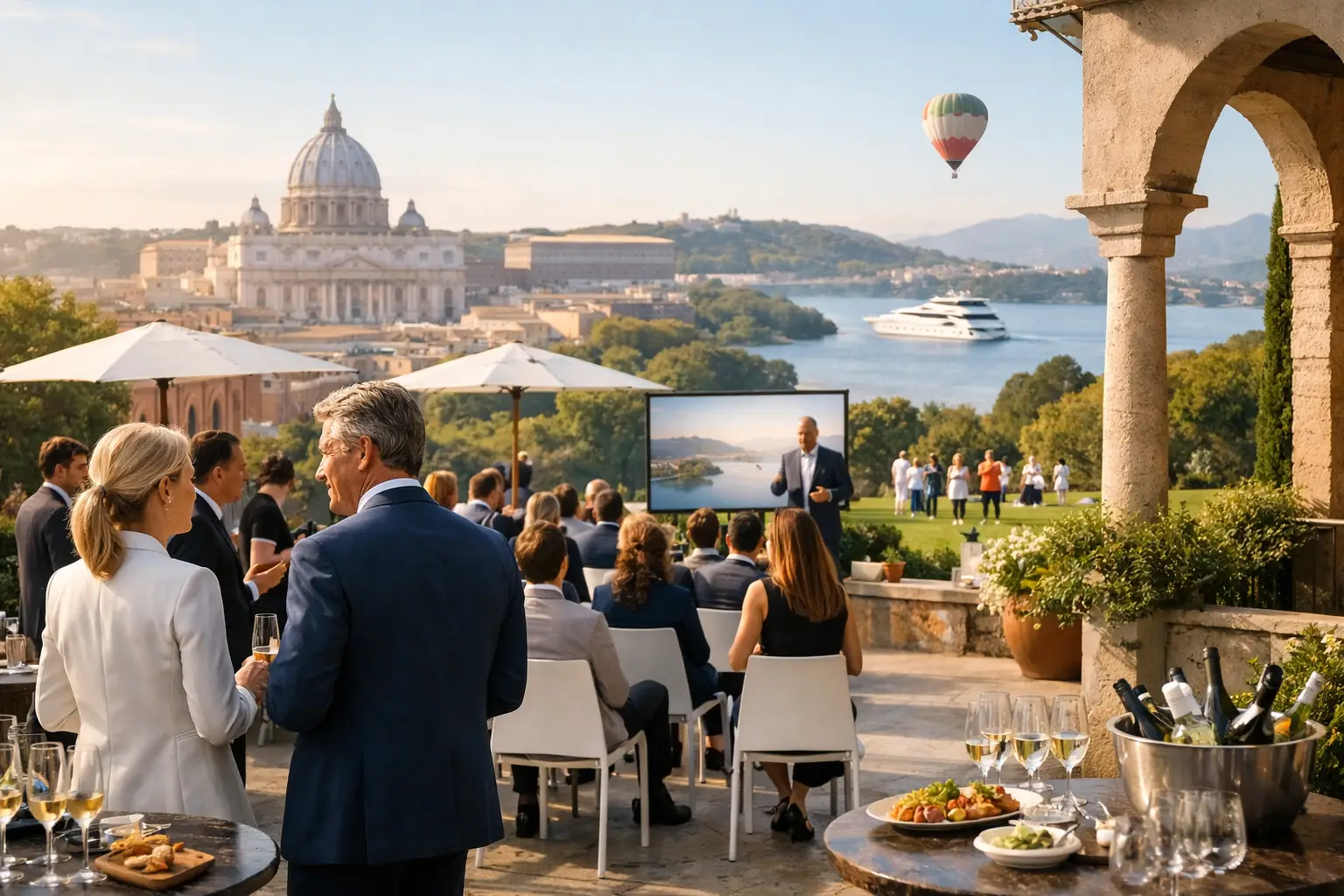
A board meeting inside a Renaissance palazzo, followed by an evening reception where every arrival, security check, dietary request, and transfer runs to the minute: this is the standard shaping corporate event trends Italy planners need to understand. International attendees still expect the emotional impact of Italy. What has changed is the level of strategy behind it. Every setting, movement, and moment must serve a clear business purpose while feeling effortless to the guest.
For agencies and corporate teams, Italy is no longer selected simply because it is beautiful. It is selected because the destination can create a distinct sense of occasion for a product launch, leadership summit, incentive, or congress. The strongest programs pair that promise with disciplined operational planning, particularly when guest lists are international, timelines are compressed, and reputations are on the line.
Corporate Event Trends Italy Is Seeing in 2026
Heritage venues are becoming working brand environments
Italy’s historic properties remain a major draw, but clients are using them with greater intention. A villa, former monastery, museum courtyard, or opera house is not merely a backdrop for photographs. It is becoming the physical expression of a brand’s values: craft, longevity, creativity, performance, or innovation.
This shift requires more than finding an exceptional venue. Heritage spaces often have access restrictions, preservation requirements, limited loading windows, and strict production rules. A gala dinner in a historic center may also require careful vehicle routing, timed guest arrivals, and a contingency plan for weather or public activity. The venue’s character should elevate the event, not introduce avoidable risk.
The best approach is to begin with the event objective, then select a setting that supports it. A fashion or design-focused gathering may benefit from Milan’s contemporary energy and industrial spaces. Florence can lend depth to executive programs built around artistry and leadership. Rome offers scale, institutional presence, and incomparable historical context. Venice remains exceptionally powerful for high-touch incentives and private gatherings, provided water logistics are planned with precision.
Smaller, more purposeful formats are gaining ground
Large congresses and company-wide meetings continue to matter, but senior audiences are placing a higher value on relevance. Rather than filling an agenda with back-to-back presentations, organizers are designing shorter sessions, curated peer exchanges, and experiences that encourage genuine conversation.
This does not mean less production or lower standards. It means a sharper guest journey. An executive retreat may include a focused morning meeting, a private cultural encounter in the afternoon, and a dinner designed around regional cuisine and discussion rather than spectacle alone. The program feels personal, but every transition still needs strong control: transportation manifests, room allocations, credentials, staffing, accessibility, and real-time communication.
For international planners, this is where local knowledge has direct commercial value. The right private visit, artisan demonstration, or chef-led experience can feel exclusive without becoming theatrical. It must also be realistic for the group size, timing, budget, and expected guest profile.
Incentives are favoring access over excess
Luxury remains central to incentive travel in Italy, but its definition has become more nuanced. Guests increasingly value privileged access, intimate hospitality, and stories they could not easily arrange independently. A private after-hours visit, a dinner in a location not ordinarily open for events, or direct time with a respected local maker can carry more meaning than an overproduced itinerary.
The trade-off is capacity. The most compelling experiences are often limited in size, and not every activity can accommodate a group of 150 or 500 without losing its quality. Strong program design may involve splitting guests into carefully managed groups, rotating experiences, or creating parallel moments that feel equally considered.
That level of customization must remain invisible to attendees. Participants should feel that the program was designed around them, not around operational constraints. Behind the scenes, however, it requires exact supplier coordination, experienced hosts, transportation control, and communication that leaves no room for assumptions.
Sustainability is moving from message to operational standard
Sustainability is no longer an optional section of an event proposal. Procurement teams, corporate responsibility leaders, and attendees are asking practical questions about sourcing, waste, transportation, materials, and local benefit. In Italy, this creates an opportunity to build responsible choices into the character of the program rather than applying generic solutions.
Seasonal menus can reduce unnecessary transport while showcasing regional excellence. Reusable event materials, digital registration, local production partners, and thoughtful routing can reduce waste and unnecessary mileage. Selecting venues close to hotels or meeting locations can improve both the guest experience and the environmental profile of the event.
There are limits to consider. Sustainability should not become a vague promise or a series of gestures that compromise event quality. A responsible program needs measurable choices, clear supplier conversations, and realistic decisions based on the destination. For example, moving a large group entirely by foot may sound appealing but may not be appropriate for mobility needs, weather conditions, or a tightly scheduled congress. The objective is responsible execution, not symbolic inconvenience.
Technology Is Improving the Guest Journey, Not Replacing Italy
Technology is most effective when it removes friction. Event apps, digital agendas, live polling, attendee messaging, and registration tools help guests navigate a complex program with confidence. For large conferences, data can also help organizers anticipate attendance patterns, manage session capacity, and communicate changes quickly.
Yet technology should support human hospitality, particularly in a destination where warmth and personal attention are part of the experience. A guest arriving at a Roman hotel after a long-haul flight does not simply need an automated notification. They may need a clear welcome point, multilingual assistance, reliable luggage handling, and immediate answers about their schedule.
Hybrid elements still have a role for global organizations with distributed audiences, especially for keynote content and training. But the in-person component must offer something a screen cannot replicate. Italy’s advantage lies in the sensory and social dimension of a live event: the architecture, cuisine, pace of shared discovery, and conversations that happen between formal sessions.
Logistics Are Becoming a Visible Measure of Quality
The most important trend is also the least glamorous. Corporate clients are evaluating destination programs through operational confidence. They want transparency on timelines, budget control, supplier responsibilities, arrival strategy, safety, and contingency planning. They expect an in-country partner to identify pressure points before they become problems.
This is especially significant in Italy’s high-demand cities. Airport arrivals can involve multiple terminals and staggered international flights. Historic centers may impose access restrictions. Major public events, seasonal crowds, and local regulations can affect routes and loading schedules. A prestigious venue can be excellent for a gala but unsuitable for daytime plenary sessions if production access, guest flow, or nearby transportation cannot support the brief.
Early planning provides options. It allows event teams to secure the right hotels, protect key venue dates, coordinate production requirements, and build realistic schedules. It also creates space for the details that guests remember: a well-paced welcome, a transfer that feels calm rather than rushed, a dinner service that starts on time, and staff who know the program well enough to respond before being asked.
For Love IT DMC, local execution begins with this discipline. Destination creativity has the greatest impact when it is supported by clear communication, trusted suppliers, and full control of the operational plan.
Designing for the Memory That Matters
The corporate events that stand out in Italy will not necessarily be the loudest or the most elaborate. They will be the ones in which the setting, content, hospitality, and logistics feel deliberately connected. Guests should understand why they are in that city, why that venue was chosen, and why each experience belongs in the program.
When planning begins, ask one practical question: what should attendees be saying to each other on the journey home? That answer can guide every decision, from the venue shortlist to the final farewell. Italy supplies the rare ingredients. Careful local planning turns them into an experience worthy of the people and the business behind it.

