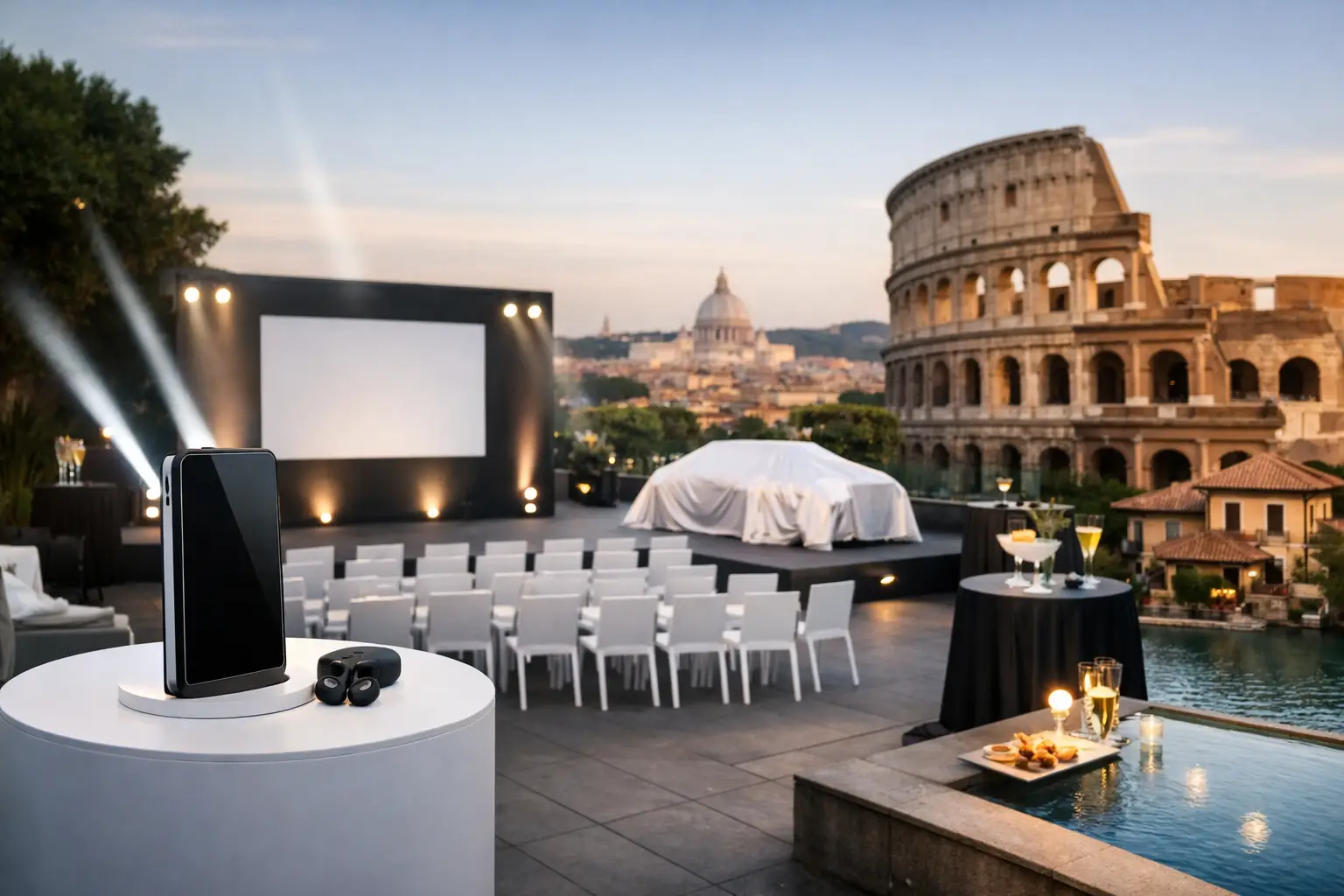
A product launch has only a few minutes to establish its point of view. The room guests enter, the route they follow, the first visual they see, and the moment the product is revealed all shape how the brand will be remembered. That is why the best venues for product launches are not simply beautiful spaces. They are environments that support a precise creative idea while giving production, hospitality, and logistics teams complete control.
Italy offers exceptional possibilities for this kind of event. A Milan industrial space can frame a technology or design debut with contemporary confidence. A Roman palazzo can add authority to a luxury collection. A Florentine courtyard can make craftsmanship feel tangible, while Venice can turn an international press launch into a destination experience. The right choice depends on more than the city or the view. It depends on the audience, the reveal, the technical brief, and the operational reality behind the experience.
What Makes a Venue Right for a Launch?
A launch venue must do two jobs at once: create anticipation for guests and enable disciplined delivery for the team. An impressive room without sufficient load-in access, rigging options, power, backstage space, or reliable guest circulation can become an expensive compromise. Conversely, a highly functional conference venue may be efficient but fail to give the product the distinction it deserves.
The strongest venue decisions begin with the launch objective. Is the event designed to generate media coverage, deepen relationships with key clients, train a sales network, host distributors, or inspire internal teams? A press-focused program needs camera-ready sightlines, interview areas, controlled acoustics, and fast connectivity. A dealer launch may need demonstration zones, plenary capacity, breakout rooms, and a practical transfer plan. For an executive audience, privacy and discretion can matter more than scale.
The product itself should also guide the search. Automotive, fashion, beauty, technology, food, and luxury goods each place different demands on a venue. A vehicle reveal requires structural assessment, vehicle access, safety planning, and enough ceiling height for an impactful staging concept. A fragrance or skincare launch benefits from intimate sensory zones and careful lighting control. For a new device, reliable power, strong Wi-Fi, and spaces for hands-on trials are essential.
Best Venues for Product Launches: Five Italian Settings
Contemporary industrial spaces in Milan
Milan is often the natural choice for launches linked to design, fashion, technology, mobility, and business innovation. Converted factories, former workshops, and contemporary event spaces provide the clean architectural lines and adaptable footprints that modern brands need. Their visual language can feel deliberate rather than decorative, leaving room for set design, projection, immersive content, and bold product staging.
These venues are particularly effective when a brand needs a blank canvas with urban credibility. They often offer easier production access than heritage properties and can accommodate larger technical builds. The trade-off is that the environment may need more creative investment to feel exclusive. Thoughtful arrival design, hospitality, lighting, and a well-managed reveal sequence make the difference.
Historic palazzi and rooftop terraces in Rome
Rome brings immediate presence. A palazzo, museum-style residence, or private terrace can give a luxury, lifestyle, or premium consumer launch a sense of permanence and prestige before the presentation begins. These settings work especially well for smaller international groups, VIP dinners, media receptions, and products that benefit from a strong cultural narrative.
Heritage venues require a more detailed operational approach. Protected interiors may limit rigging, open flame, sound levels, branding applications, and build times. Access can be constrained by historic streets, and guest transfers must be planned around traffic patterns and security requirements. With early technical assessments and a clear production plan, those constraints become part of a highly curated experience rather than a last-minute obstacle.
Renaissance courtyards and design venues in Florence
Florence is a compelling setting for brands rooted in craftsmanship, beauty, heritage, fashion, and fine food. Renaissance courtyards, garden settings, galleries, and restored residences offer texture that cannot be replicated with a standard scenic build. They suit launches where materiality, detail, and storytelling are central to the message.
A courtyard reveal can be particularly effective at dusk, moving guests from an intimate welcome into a fully transformed central space. However, outdoor programs require a credible weather solution, and historic-city logistics demand careful scheduling for deliveries and guest movement. The best plan protects the atmosphere without relying on perfect conditions.
Waterfront and island venues in Venice
Venice is not a practical choice for every launch, which is exactly why it can be so powerful for the right one. Palaces on the Grand Canal, private islands, and waterfront venues can create genuine scarcity and anticipation. For a global brand hosting editors, top clients, or executive stakeholders, arrival by boat becomes part of the story rather than a transfer detail.
The operational requirements are more specialized. Freight, staging, catering, guest luggage, and accessibility must be coordinated across water and land routes. Capacity can be more limited than in Milan or Rome, and weather contingencies need real attention. For invitation-only launches where guest experience matters as much as audience size, Venice can deliver a level of memorability that few destinations match.
Resort estates and countryside properties
For products that benefit from time, privacy, and an immersive setting, an estate outside a major Italian city can be the better answer. This format works well for automotive test drives, wellness launches, luxury hospitality collaborations, and multi-day brand experiences. Guests can move from presentation to demonstration, dining, and accommodation without breaking the atmosphere.
The value lies in control. A private estate can allow a brand to shape every touchpoint, from the first welcome to the final dinner. It does, however, place greater responsibility on transportation, room-block management, technical infrastructure, and contingency planning. The venue may be spectacular, but the program succeeds only when every guest reaches it comfortably and every supplier can operate efficiently.
Evaluate the Guest Journey Before the Ballroom
The main event room is rarely the full story. Guests form their first judgment at the airport, hotel, transfer vehicle, and registration point. A venue that appears ideal on a site visit can be less suitable if arrivals are fragmented, queues form at security, or the route from entrance to reveal is unclear.
Map the experience from the guest perspective. Consider where coaches can drop off, how VIPs are separated from general arrivals, whether there is a covered holding area, and how guests move between reception, presentation, product interaction, and dining. For international audiences, clear multilingual signage and well-briefed hosts matter. So does pacing: a short wait can build anticipation, while an unexplained delay can drain energy from the room.
Production teams need a separate journey. Ask where trucks unload, how equipment reaches the event space, whether lifts can handle scenic elements, and how long the venue permits for installation and dismantling. Check noise restrictions, local permitting, emergency exits, fire safety, and backup power early. These details are not secondary to creativity. They protect it.
Build the Venue Search Around Non-Negotiables
A productive venue brief separates essential requirements from desirable features. Capacity is only the starting point. A room may hold 500 guests for a reception but far fewer for a theater-style reveal with camera positions, a stage, product plinths, interpretation booths, and circulation around the experience zones.
Technical specifications should be confirmed rather than assumed. Ceiling height, floor loading, daylight control, rigging points, power distribution, internet redundancy, acoustics, and broadcast capability all influence what the creative team can deliver. If the event includes live streaming or hybrid attendance, test connectivity from the actual presentation location, not only from a sales brochure.
It is equally wise to define the hospitality standard. Is the launch a 90-minute presentation followed by cocktails, or a full evening with a seated dinner and entertainment? Do guests need private salons for interviews, makeup, product briefings, or executive meetings? A venue that supports both the public moment and the private work around it will reduce unnecessary transfers and preserve momentum.
Local Knowledge Turns Character Into Control
Italy’s most distinctive venues often come with specific access rules, supplier processes, neighborhood restrictions, and preservation requirements. Those are manageable when addressed at the beginning, not when the creative concept is already approved. Local coordination helps align venue management, production partners, caterers, transport teams, security, and municipal requirements around one workable schedule.
For international planners, that coordination is where an in-country partner adds real value. Love IT DMC approaches venue sourcing as part of the entire event design, assessing not only visual impact but also transfer times, guest flow, production feasibility, and service standards. The goal is to make a remarkable setting feel composed and dependable from the first briefing to the final departure.
A product deserves more than a dramatic backdrop. Choose a venue that gives the idea room to perform, gives guests a story worth retelling, and gives your team the confidence to deliver every moment exactly as intended.

