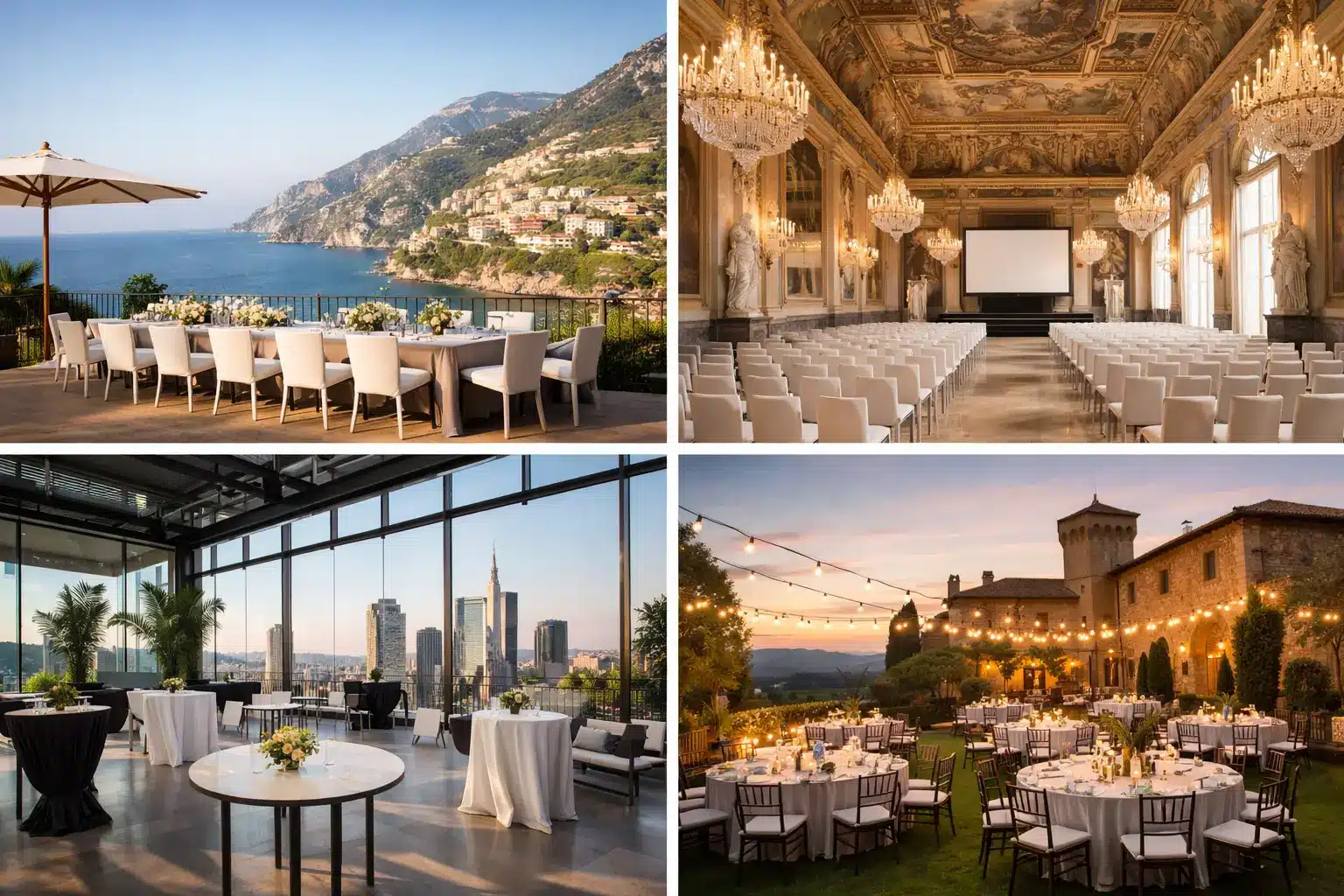
A venue in Italy should do more than provide a remarkable backdrop. For international brands, the right setting must carry the creative idea, accommodate technical ambition, and move guests confidently from arrival to final departure. That is the standard behind the top venues for brand events in Italy: places where cultural significance and operational readiness can work together.
A Renaissance palazzo may be ideal for an executive dinner, but less suitable for a product reveal requiring heavy rigging and overnight load-in. A converted industrial space may support a bold production schedule, while asking more of the guest transportation plan. The strongest choice begins with the event objective, then tests every beautiful possibility against access, capacity, production conditions, permissions, and timing.
What makes a venue right for a brand event in Italy
Italy offers exceptional range, from monumental halls and historic villas to contemporary museums, congress centers, and former factories. Yet heritage alone does not make a venue event-ready. International planners need a setting that can protect the guest experience while meeting the practical demands behind it.
For a press event or automotive launch, loading access, staging clearances, power distribution, and controlled sightlines may lead the brief. For a leadership summit, privacy, acoustics, nearby hotels, and discreet security are usually more decisive. Gala dinners require a different balance: arrival drama, dining layout, kitchen access, late-evening permissions, and a dependable rain plan if the concept includes an outdoor reception.
The destination also changes the equation. Rome rewards programs that need grandeur and political or cultural weight. Milan is often the most direct choice for design, fashion, innovation, and large-scale international access. Florence creates intimacy and artistic distinction, while Venice delivers an arrival experience that guests rarely forget, provided water logistics are planned with precision.
Top venues for brand events in Italy by destination
Rome: Palazzo Brancaccio for formal brand storytelling
Palazzo Brancaccio is one of Rome’s most compelling choices for gala dinners, premium receptions, awards ceremonies, and private brand occasions. Its richly decorated interiors bring immediate theater to an arrival, allowing a program to feel distinctly Roman without relying on excessive scenic design.
It is particularly effective when the event format benefits from a sequence of spaces: welcome drinks, seated dinner, entertainment, then an after-dinner moment in a separate room or garden setting. The operational work is in careful room planning. Heritage venues require production teams to work respectfully around protected finishes, defined access routes, and venue-specific timing. With the right advance coordination, these constraints become part of a controlled, elegant delivery rather than a last-minute concern.
Rome: La Nuvola for conferences and major launches
For congresses, general sessions, exhibitions, and high-attendance corporate programs, La Nuvola provides a contemporary counterpoint to Rome’s historic venues. Its scale, meeting infrastructure, and adaptable event areas make it a strong candidate for brands that need substantial production capacity and a clear delegate journey.
This is a venue for programs where registration, session changes, sponsor presence, catering peaks, and simultaneous content tracks must be managed at volume. Its EUR location calls for an intelligent hotel and transportation strategy, especially when attendees are staying across central Rome. The advantage is that event movement can be designed with clarity from the airport transfer through the closing session.
Milan: Fondazione Prada for design-led experiences
Fondazione Prada offers a distinctive environment for brands working in fashion, luxury, architecture, art, technology, and culture. Its mix of industrial structures and contemporary artistic identity creates an atmosphere that feels editorial rather than conventional.
This is not the choice for every large plenary or standardized corporate dinner. It is most powerful when the brand wants guests to encounter an idea, not simply enter a room. Product presentations, curated dinners, intimate conferences, and creative receptions can gain real value from the setting. Detailed approval processes, installation requirements, catering parameters, and guest circulation should be addressed early, particularly where an event concept includes custom-built elements or high-touch hospitality.
Milan: Superstudio Maxi for production flexibility
When a creative concept requires a blank canvas, Superstudio Maxi is among the most useful Milan options. Its contemporary spaces are well suited to product launches, immersive installations, fashion-adjacent presentations, trade events, and high-impact evening programs.
The appeal is not historical ornament. It is the ability to build a branded environment with strong technical control. Event planners can prioritize lighting design, LED content, custom stages, vehicles, demonstrations, and flexible guest flows without forcing the concept into a heritage floor plan. Milan’s airport connectivity and broad hotel inventory add to its appeal, although traffic windows and loading schedules remain essential considerations during major citywide events.
Florence: Stazione Leopolda for large creative formats
Stazione Leopolda, a former railway station, brings generous volume and industrial character to Florence. It is a persuasive choice for conferences, exhibitions, fashion events, brand activations, and gala formats that need more scale than a traditional palazzo can comfortably offer.
Florence is often selected for its intimate, highly memorable atmosphere, but that does not mean it cannot host ambitious programs. Stazione Leopolda gives production teams room to work while keeping guests close to the historic center and the destination’s hotel base. The venue is especially useful for a program that pairs a daytime business agenda with a visually transformed evening celebration.
Florence: Palazzo Vecchio for leadership moments
For a select audience, Palazzo Vecchio offers a setting of extraordinary authority. A dinner, ceremony, or executive gathering in its historic halls has an inherent sense of occasion that is difficult to replicate in a modern venue.
Its strengths are prestige, centrality, and cultural resonance. Its trade-off is that it works best with a disciplined guest count and a concept that respects the building’s character. Planners should treat it as the defining moment within a wider program, perhaps following a meeting in a more technically flexible hotel or conference venue. This approach protects both the guest experience and the event’s operational rhythm.
Venice: Arsenale for scale and spectacle
The Arsenale brings rare scale to Venice. Its historic waterfront complex can support major receptions, dinners, exhibitions, and presentations while retaining a character that is unmistakably Venetian and far removed from a standard ballroom.
The venue’s drama is amplified by arrival by boat, but that same quality makes marine logistics central to the plan. Guest manifests, dock timing, vessel capacities, weather contingencies, and staggered departures all deserve the same attention as the stage design. For brands willing to plan precisely, the result is a guest journey that begins before attendees reach the venue door.
Venice: Scuola Grande di San Rocco for intimate distinction
Scuola Grande di San Rocco is suited to smaller, high-value gatherings where art, history, and atmosphere matter as much as the formal agenda. Its interiors offer a powerful setting for private dinners, cultural receptions, and executive hospitality.
Because Venice rewards thoughtful pacing, this venue works particularly well as part of a carefully choreographed evening: a private walking arrival, a short cultural introduction, and an elegant dinner with limited production intrusion. It is not designed for a heavily built spectacle. It is designed for guests to feel they have been welcomed into a place of genuine significance.
How to shortlist venues without compromising the concept
A reliable shortlist usually includes one aspirational choice, one operationally efficient choice, and one option that balances both. This prevents the process from becoming a search for the most photogenic room rather than the venue most likely to deliver the brief successfully.
Before presenting venues to stakeholders, confirm whether the proposed format can be delivered within the venue’s permitted hours, technical rules, and access limitations. Review guest transfer times at the precise hours guests will travel, not only on a map. Ask how catering reaches the space, where crew can work, how suppliers enter and exit, and what happens if weather affects the plan. These details determine whether an event feels effortless.
It is also wise to distinguish between a venue that photographs beautifully and one that creates a coherent live experience. A grand frescoed hall may be unforgettable for 120 guests at dinner. The same space may feel crowded for 250 guests, a stage, and an awards presentation. Scale should be judged against the actual event design, not headline capacity alone.
Build the venue into the guest journey
The most successful Italian brand events do not treat the venue as a backdrop rented for a few hours. They make it part of the narrative. A Milan industrial space can frame a future-facing innovation story. A Florentine palace can give a leadership recognition program the weight of legacy. Venice can turn a transfer into the opening scene of the event.
That requires local operational control from the first site inspection through final load-out. Love IT DMC helps international teams align venue character with transportation, production, catering, guest management, and the many local conditions that shape delivery. The result is not simply an impressive address, but a setting that performs precisely when the brand is on display.
Choose the venue that makes your audience feel the purpose of the event before the first presentation begins – then give every logistical detail the same level of attention.

