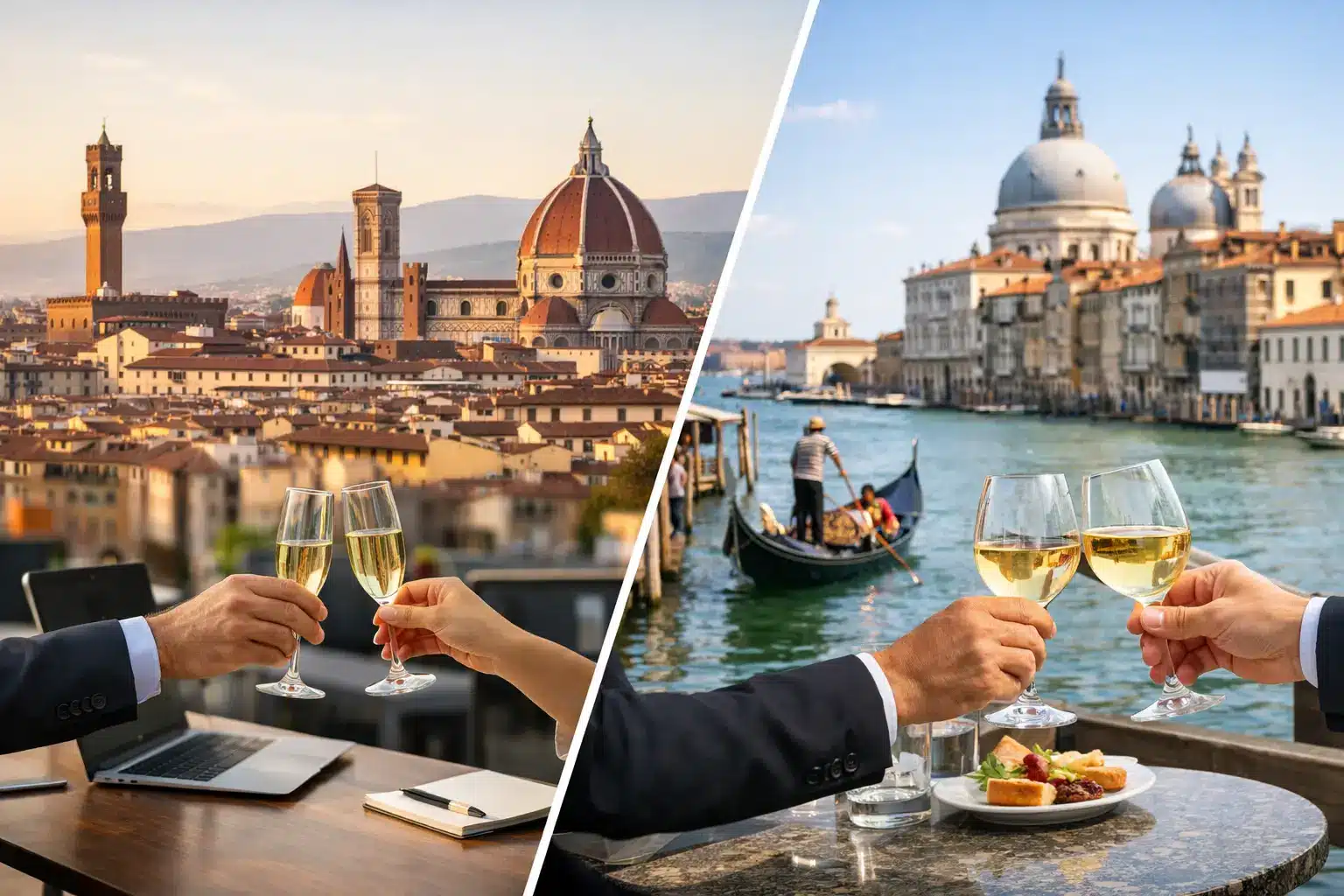
A destination choice can shape the entire emotional arc of an incentive. In the Florence vs Venice incentive events decision, the question is not which city is more beautiful. Both are extraordinary. The real question is which setting best supports your audience, program objectives, arrival pattern, budget parameters, and standard of guest experience.
Florence delivers Renaissance grandeur with a compact, highly manageable city center. Venice creates immediate theater: boats replace coaches, palaces rise from the water, and each arrival feels deliberately removed from ordinary business travel. For international agencies and corporate teams, the right answer depends on the operational discipline behind the creative idea.
Florence vs Venice Incentive Events: The Strategic Difference
Florence is often the stronger choice when an incentive requires flexibility, efficient movement, and a strong balance between culture and contemporary hospitality. Its scale allows guests to walk between leading hotels, museums, restaurants, artisan workshops, and landmark event spaces. This is a significant advantage for programs with tight schedules, mixed fitness levels, or a high number of concurrent experiences.
Venice is better suited to incentives where exclusivity, surprise, and destination drama lead the brief. The city is inherently experiential. A private boat transfer across the lagoon, a reception in a historic palazzo, or dinner overlooking the Grand Canal establishes a sense of occasion before the first welcome speech begins. Venice asks more of the operating team, but it rewards careful planning with a setting few destinations can match.
Neither city should be selected on postcard appeal alone. A three-night executive reward program for 80 top performers has different requirements from a 400-person sales incentive with multiple arrivals, partner attendance, and formal recognition moments. The destination must work as hard as the concept.
Access and Arrival Experience
Florence is generally more straightforward for international groups arriving through Florence Airport or via high-speed rail from Rome and Milan. For larger long-haul groups, arrivals through nearby airports can be coordinated with private transfers into the city. Coach access, luggage handling, and hotel check-in procedures are comparatively direct, particularly when groups are spread across several properties.
Venice has a more distinctive arrival sequence and a more complex one. Guests typically enter through Venice Marco Polo Airport, then continue by private water taxi, shared boat, or land transfer followed by boat service. This is part of Venice’s appeal, yet it introduces practical considerations. Boat capacity, luggage volume, weather, dock access, hotel landing points, and staggered flight arrivals all need to be mapped in detail.
For a smaller premium group, the Venetian transfer is often a highlight. For a large group with a compressed arrival window, it requires precise manifests, porters, clear signage, multilingual hosts, and contingency planning. The experience can feel effortless to guests only when the logistical work behind it is exact.
Venue Character and Event Scale
Florence offers an exceptional range of venues for meetings, gala dinners, and cultural events. Renaissance palaces, cloisters, garden terraces, theaters, and museum spaces can support a program with visual depth while remaining close to hotels. The city also has strong options for plenary sessions and conference infrastructure, making it particularly effective for incentives that combine business content with reward experiences.
A Florence gala can move from an aperitivo in a historic courtyard to dinner beneath frescoed ceilings, followed by a performance or brand reveal in a setting that feels authentically Italian rather than staged. The city has enough operational capacity to accommodate ambitious production, including lighting, staging, entertainment, and guest transportation, without turning every movement into a major operation.
Venice excels when venue choice itself is intended to be the headline. Historic palaces, private islands, grand salons, waterside terraces, and former religious complexes provide a rare sense of privilege. A dinner within a palazzo can feel deeply personal, even at a meaningful scale, because access is defined by water and the city unfolds in layers.
However, Venice has more physical constraints. Loading times, boat schedules, narrow access points, protected buildings, sound restrictions, and weather exposure must influence event design from the beginning. Not every impressive venue is suitable for extensive technical production or large-scale arrivals. A skilled destination partner will assess not only visual impact, but also guest circulation, supplier access, backup power, restroom capacity, and departure timing.
Guest Flow: Where Each City Performs Best
Florence is naturally suited to programs with choice and momentum. Guests can join a private museum visit, leather workshop, food experience, art-focused walking itinerary, or Tuscan countryside excursion without losing hours to transfers. It is an excellent destination for audiences that want to engage with local culture actively, rather than observe it from a distance.
This accessibility also makes Florence effective for mixed groups. Executives can attend a strategic meeting while partners enjoy curated cultural programming, then reunite easily for an evening celebration. The city supports different pace preferences without making the program feel fragmented.
Venice is more controlled by geography. That can be an advantage. Once guests are within the city, the water-based environment creates a focused, immersive atmosphere. There are fewer casual distractions and less temptation for attendees to divide into separate directions. For leadership groups, recognition trips, and high-value client programs, this concentration can strengthen connection.
The trade-off is that every group movement deserves a detailed plan. A simple dinner transfer may involve several boats, multiple docks, timed boarding, and guides positioned at key points. Venice is not difficult when managed well, but it is not forgiving of casual planning.
Cultural Programming and Incentive Impact
Florence speaks to craftsmanship, intellectual heritage, design, and the Renaissance ideal of human achievement. It works especially well for brands connected to luxury, fashion, technology, architecture, finance, or innovation. Guests can meet artisans, experience private collections, discover regional cuisine, or travel into the Chianti hills for vineyard settings and open-air celebrations.
Venice communicates rarity, imagination, and escape. Its strongest programs use the city beyond the expected gondola image. Consider private access to a glassmaking atelier, a masked evening inspired by Venetian tradition, a lagoon journey to a private island, or a music performance in an atmospheric historic space. The destination lends itself to storytelling, particularly for brands seeking a high-touch reward rather than a broad cultural survey.
In both cities, authenticity matters. Experiences should be selected for relevance and quality, not simply because they are traditionally Italian. A well-designed incentive gives guests access they could not arrange independently and creates moments that support the client’s message.
Budget and Operational Considerations
Florence often provides more cost control across transportation, venue operations, and group dining. Its compact layout can reduce transfer requirements, and the wider surrounding area provides additional options for off-site events. This does not make Florence a lower-end choice. It simply allows investment to be directed toward exclusivity, production, cuisine, or personalized programming rather than complex movement.
Venice typically requires a more generous operational allowance. Water transport is essential, not optional, and supplier timing must account for the city’s unique access conditions. Premium hotels, exclusive venues, and private boat services can create a high-value program, but budgets should reflect the destination’s infrastructure and the level of control required to deliver it well.
There are periods when this distinction becomes sharper. Major cultural events, holiday weekends, and peak summer dates can affect availability and pricing in both cities. Venice, in particular, benefits from early venue and hotel commitments. Florence may offer more flexibility, though the most sought-after properties and heritage venues also book well ahead.
Choosing the Destination With Confidence
Choose Florence when the brief calls for operational flexibility, a strong business-and-incentive balance, active cultural discovery, and efficient movement for a larger or more varied group. Choose Venice when the objective is to create a singular, elevated reward experience where every transfer, view, and venue contributes to a sense of exclusivity.
The most effective decision is made after reviewing the actual program architecture: attendee profile, group size, flight origins, meeting requirements, preferred hotel standard, production expectations, and desired emotional outcome. Love IT DMC approaches that process from both sides – protecting the operational detail while shaping an Italian experience guests will remember long after the final departure.
A clear brief is the best starting point. Define what attendees should feel, what the business needs them to take away, and where the program cannot compromise. From there, Florence or Venice becomes more than a destination choice. It becomes the right stage for the incentive you intend to deliver.

